Ingredients
Equipment
Method
Make the dough (day 1)
- Combine the cold milk, yeast, cardamom and all but about ½ cup (60 g) of the flour in the bowl of a stand mixer. Mix on low until it comes together, then knead on medium-low for 10 minutes. The dough will look plain and stiff at this stage — that's what you want.
- Now add the salt, sugar, soft butter and egg. Keep kneading, adding the last of the flour a little at a time, until the dough is smooth, elastic and pulls cleanly away from the bowl. This takes another 8–10 minutes; the dough will loosen and look broken when the butter goes in, then come back together.
- Check the gluten with a windowpane test: stretch a piece of dough thin enough to see light through it without tearing. If it tears, keep kneading.
- Round the dough into a tight ball, cover, and refrigerate overnight (8–14 hours).
Fill and shape (day 2)
- Stir the melted butter, both sugars, cinnamon and cardamom into a spreadable paste.
- Roll the cold dough on a lightly floured counter into a rectangle roughly 16 × 20 in (40 × 50 cm), about ¼ in (5 mm) thick. Spread the filling evenly over the whole surface.
- Fold the dough in half so the filling is enclosed, then cut across into strips about ¾ in (2 cm) wide — a bench scraper gives the cleanest cut. You should get 17 strips.
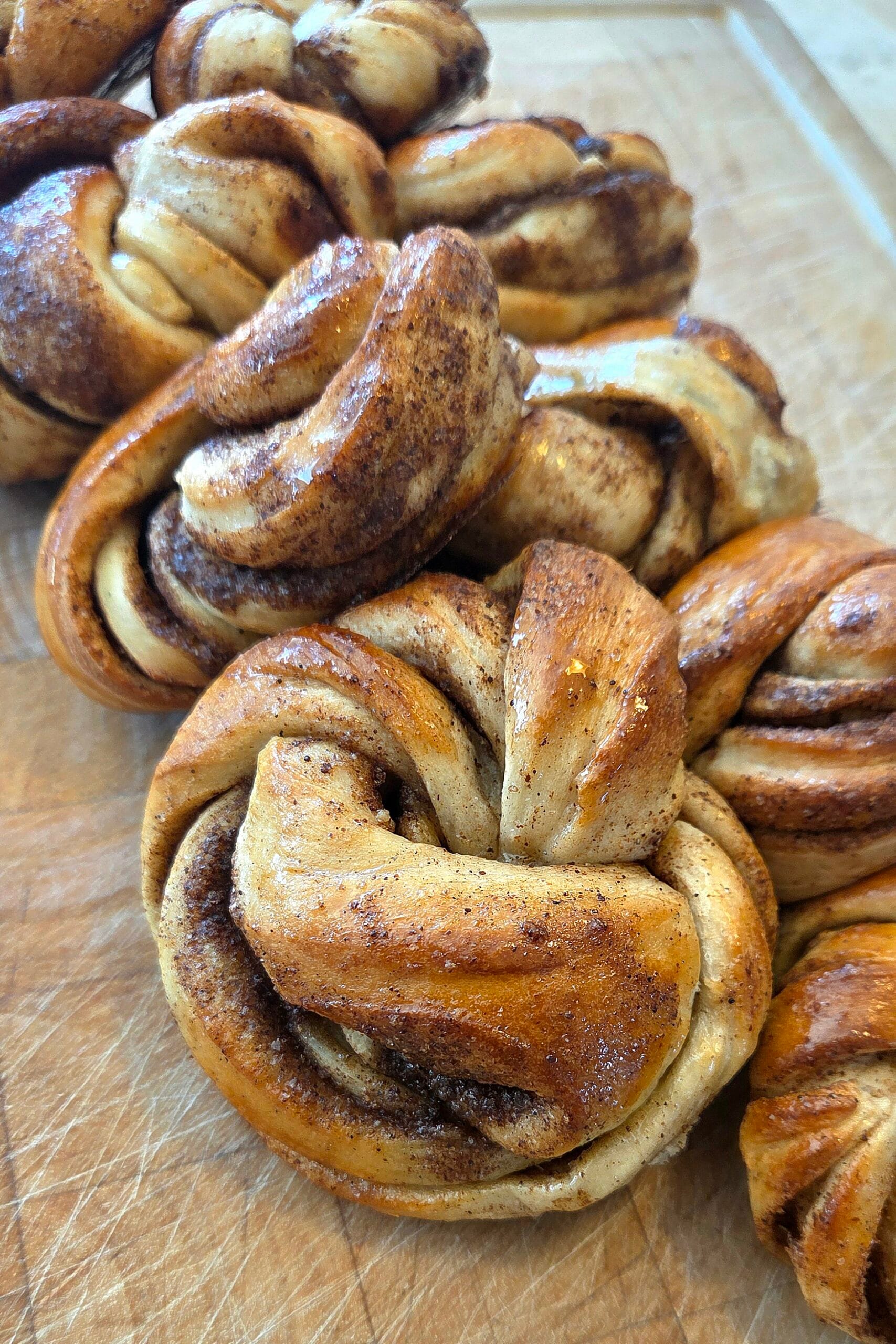
- Take a strip, stretch it gently, twist it two or three times, then wrap it around two fingers and tuck the end underneath. Place on a parchment-lined sheet with room to expand.
- Cover and let the knots proof at room temperature for about 1½ hours, until visibly puffy and soft to the touch. Cold dough takes its time — go by look, not the clock.
Bake and glaze
- Heat the oven to 400°F (200°C). Brush the knots with beaten egg.
- Bake for 12–14 minutes, until deep golden.
- While they bake, bring the sugar and water to a boil, stirring until clear.Brush the hot syrup over the knots the moment they come out of the oven, then move them to a wire rack — the syrup soaks in and sets glossy as they cool.
Notes
Chef's tip: the overnight cold proof is the whole recipe. A cold, rested dough is firm enough to roll thin and hold a sharp twist, so the swirl stays defined instead of blurring, and the long ferment builds flavor you can't get from a two-hour dough. It also splits the work: 45 minutes on day 1, shaping and baking on day 2.