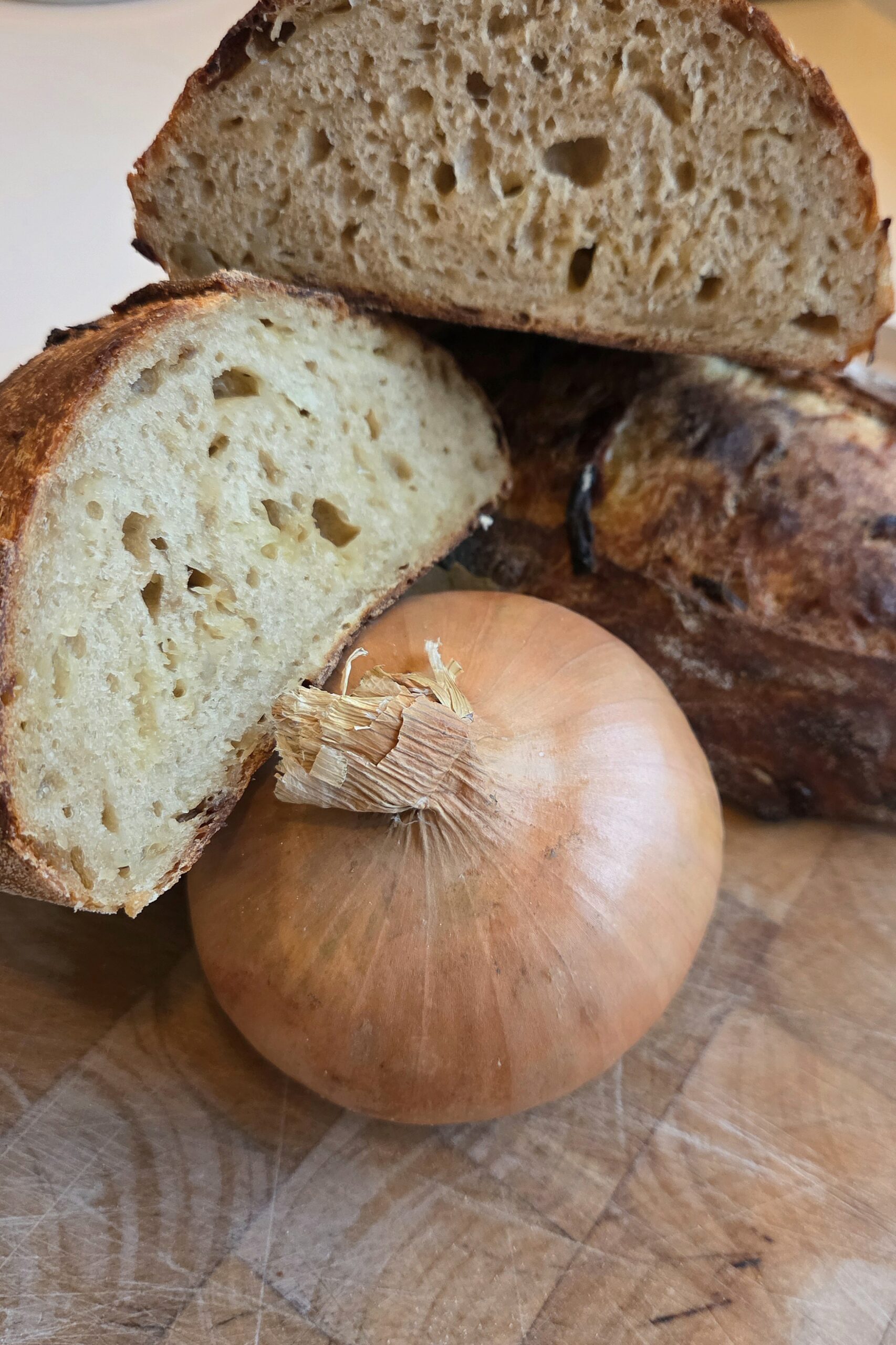
Ingredients
Equipment
Method
Brown the onions (the day before, or the morning you mix)
- Brown the onions. Cook the sliced onions in the oil in a heavy skillet over medium-low heat for 45–60 minutes, stirring every few minutes, until deep amber and soft. They reduce to about 230 g. Leave them unsalted.
- Chill them. Spread the onions on a plate and let them cool completely, in the fridge if needed, before they go into the dough.
Day 1: mix and ferment
- Feed your starter the morning you mix. Use it when it has roughly doubled and looks domed and bubbly.
- Mix and rest. Whisk the starter into the stock, add both flours and mix until no dry flour remains. Hold back the salt. Cover and rest 1 hour. The dough already feels firmer than a water dough at this stage.
- Add the salt. Sprinkle the 11 g over the dough and squeeze it through until you can't feel any grains.
- Stretch and fold, 4 sets every 30 minutes. This dough stretches less than our water loaves, so stop each fold when it resists instead of forcing it. Our Stretch & Fold Timer counts the sets for you.
- Fold in the onions and cheese on the last set. Flatten the dough, scatter the cold onions and the diced Jarlsberg over it, and fold it over itself until they are evenly spread.
- Bulk ferment until risen about 30%. Expect it to take longer than our other loaves It is ready when the top is domed and slightly puffy with a few bubbles along the sides.
- Divide in two. Turn the dough out and cut it into two pieces of about 810 g. Round each one loosely.
- Bench rest 20–30 minutes, uncovered, until the dough has relaxed and spread slightly.
- Shape. Use the bench scraper to pull each piece into a taut round against the counter.
- Into the bannetons, seam side up, in linen cloths dusted with rice flour.
- Cold retard 12–16 hours in the fridge.
Day 2: bake
- Preheat 45–60 minutes. Perforated tray on the middle rack, metal roasting tray on the rack below, oven at 480°F (250°C).
- Score. Turn out the cold loaves, brush off excess flour and make one deep cut along each.
- Bake with steam, 20 minutes. Slide both loaves onto the hot tray, pour 240 ml (1 cup) boiling water into the roasting tray and close the door quickly.
- Finish dry, 15 minutes. Remove the steam tray, drop to 400°F (200°C) and bake until the center reads 205–210°F (96–99°C). The crust goes dark sooner than on a water dough, so trust the thermometer over the color.
- Cool at least 2 hours on a wire rack before slicing.
Notes
Chef's tip: Weigh the onions when they come off the heat. Much more than 230 g means they still hold water, so give them more time in the pan. Wet onions slacken a dough that has little water to spare, and they must be fully cold before the last fold.
- Another stock: the salt in this recipe is set for ours, so recalculate it for yours (more on why below). A thinner, unreduced broth makes a softer dough that rises more like our water loaves.
- Swapping the cheese: keep it at 240 g and cut it in ¼ in (½ cm) dice. Shreds melt into the crumb and disappear.
- Storage: best within 2–3 days, cut side down on a board. Slices freeze well and go straight into the toaster.