Go Back
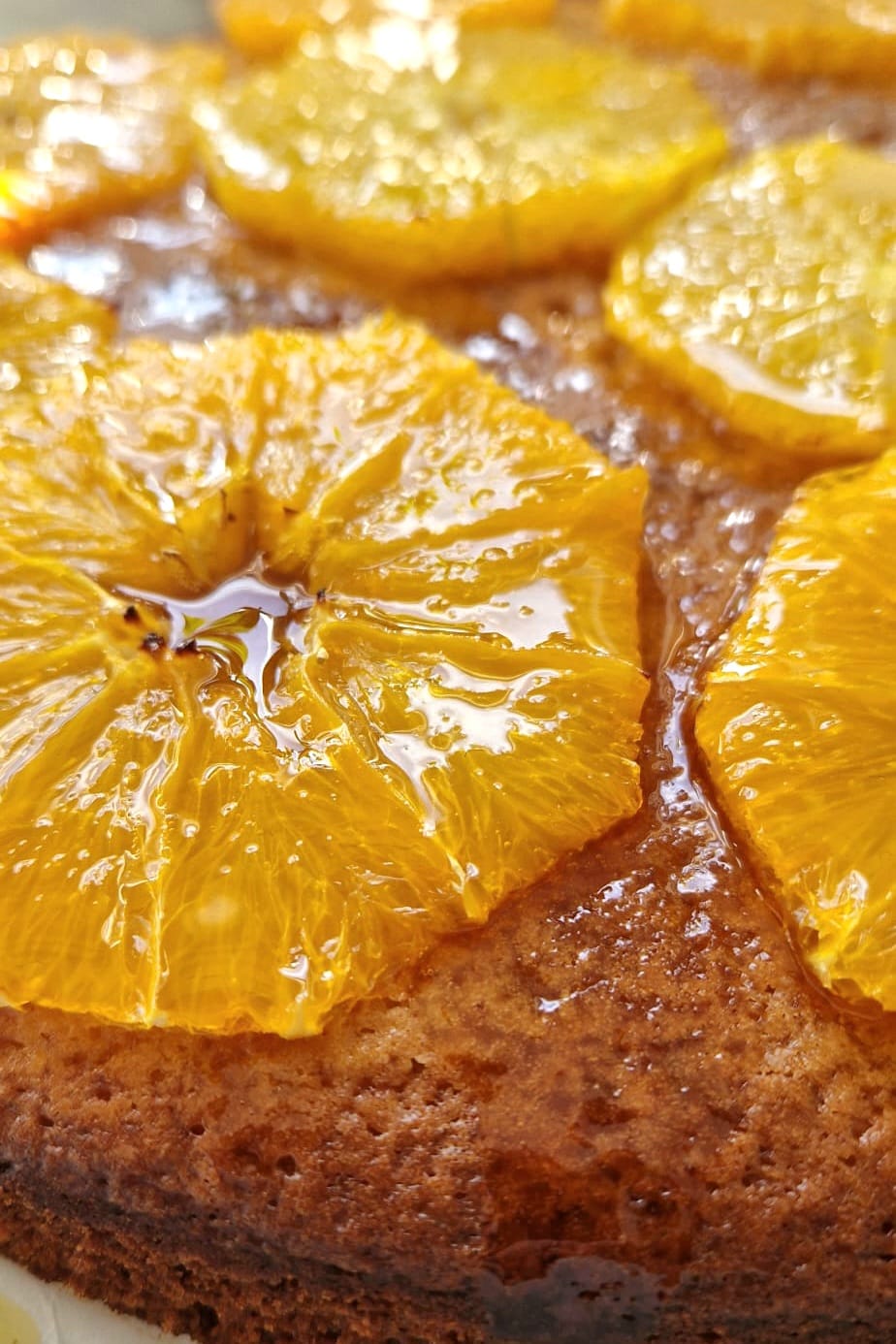
Close-up of a moist orange cake with glossy syrup-soaked orange slices arranged on top

Moist Orange Cake with Sticky Orange Syrup

A moist orange cake soaked in warm citrus syrup and topped with glossy orange slices — a simple Nordic coffee cake that stays tender for days.
Prep Time 25 minutes
Cook Time 1 hour
Soaking & Cooling 1 hour
Total Time 2 hours 25 minutes
Servings: 12 slices
Course: Dessert
Cuisine: Norwegian, Scandinavian

Ingredients
  

Cake
  • 300 g unsalted butter 1⅓ cups, softened, room temperature
  • 255 g granulated sugar 1¼ cups
  • 5 large eggs room temperature
  • 1 orange zest only
  • 75 ml orange juice 5 tbsp
  • 360 g all-purpose flour 3 cups
  • 1½ tsp baking powder
Orange Syrup & Topping
  • 150 ml fresh orange juice 2/3 cup, juice of about 2 oranges
  • 50 g granulated sugar ¼ cup
  • 2 oranges peeled, sliced about ¼ inch (5 mm) thick, seeds removed

Equipment

  • 9-inch (22 cm) springform pan A springform makes it easy to release this rich, syrup-soaked cake without breaking it.
  • Digital kitchen scale This batter is heavy on butter and flour — weighing beats cups every time.
  • Stand mixer Creaming 300 g of butter and sugar to properly light and pale takes a good 5 minutes.
  • Microplane zester Takes the orange zest without the bitter white pith underneath.
  • Wire cooling rack Essential here — the cake soaks while it cools, and you want air underneath.
  • Wooden skewer For testing doneness and poking the holes the syrup runs into.

Method
 

Cake
  1. Heat the oven to 350°F (175°C). Butter a 9-inch (22 cm) springform pan and line the base with parchment.
  2. Beat the butter and sugar until pale, light and creamy — a full 4–5 minutes. This is where the cake gets its lift, so don't cut it short.
  3. Add the eggs one at a time, beating well after each one before adding the next. The batter should stay smooth and glossy.
  4. Mix in the orange zest and 5 tbsp (75 ml) orange juice.
  5. Sift the flour and baking powder together and fold into the batter until just combined. Scrape the bowl once so nothing hides at the bottom.
  6. Spoon the batter into the pan and level the top. Bake on the lowest oven rack for about 45 minutes, until the top is set but not yet fully baked through. Lay the orange slices over the top in a single layer, then return the cake to the oven for another 15 minutes, until the slices have caramelized lightly at the center and a skewer comes out clean. If the top browns early, tent it loosely with foil.
Orange Syrup & Topping
  1. While the cake bakes, warm the orange juice and sugar in a small saucepan, stirring just until the sugar dissolves. Don't reduce it — you want a thin, pourable syrup that soaks in.
  2. Take the cake out of the oven, release the springform ring and set the cake — still on the springform base — on a wire rack over a tray.
  3. Prick the warm cake all over with a wooden skewer, between the orange slices and right down into the crumb.
  4. Slowly spoon the warm syrup over the top, letting it soak in between additions. The syrup gives the baked slices a glossy, sticky finish.
  5. Leave the cake on the rack until completely cool before slicing. It gets better on day two.

Notes

Chef's tip: everything goes in at room temperature — butter, eggs, juice. With this much butter, cold eggs will split the batter and you lose the air you just spent five minutes beating in. If it does curdle, add a spoonful of the measured flour and keep mixing; it comes back together.
Soak while both are warm. A warm crumb drinks the syrup; a cold one lets it run straight off onto the tray. That's the whole difference between a moist orange cake and a dry one with sticky spots.
Make ahead: the cake keeps well covered at room temperature for 3–4 days and the crumb actually improves overnight as the syrup settles.
Pan options: a small sheet pan or a bundt/ring tin both work. Both bake faster than the springform, so start checking with a skewer well before the hour is up — a clean skewer means it's done.
Weigh the flour if you can. 3 cups is an approximation — 360 g is the number that matters.