Go Back
Sliced sourdough discard blueberry loaf with lemon glaze and lemon zest on parchment paper

Lemon Tart with Italian Meringue

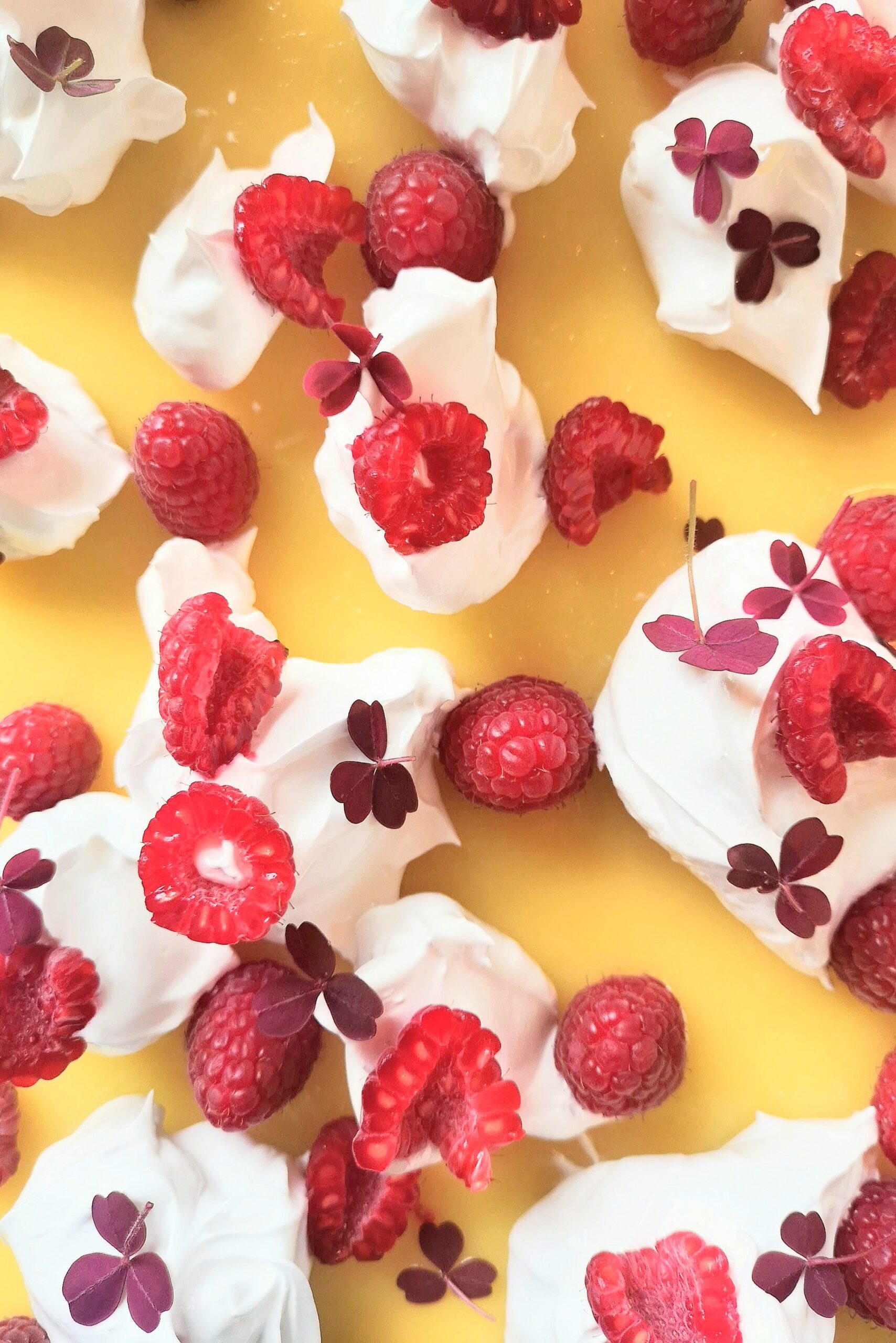
Lemon tart with Italian meringue — crisp chocolate-lined shortcrust, silky lemon curd and glossy torched meringue, finished with fresh raspberries.
Prep Time 45 minutes
Cook Time 25 minutes
Chilling & setting 3 hours
Total Time 4 hours 10 minutes
Servings: 10 slices
Course: baking, Dessert
Cuisine: european

Ingredients
  

Shortcrust paysty
  • 100 g powdered sugar ¾ cup + 1 tbsp icing sugar
  • 200 g unsalted butter ¾ cup + 2 tbsp cold, cubed (1¾ sticks)
  • 300 g all-purpose flour 2½ cups
  • 1 large egg
  • 1 tsp fine salt
  • 1 tsp vanilla sugar optional — or 1 tsp vanilla extract
  • 1 tbsp cold water only if the dough feels dry
  • 50 g dark or white chocolate melted, for sealing the baked shell
Lemon curd
  • 75 g fresh lemon juice ⅓ cup, about 2 lemons
  • 75 g granulated sugar 6 tbsp
  • 125 g unsalted butter ½ cup + 1 tbsp, cubed
  • 3 large eggs 150 g
  • 75 g granulated sugar 6 tbsp
  • 2,5 g gelatin ¾ tsp — powdered: bloom in 1 tbsp cold water. Sheets: use 1½ sheets (2.5 g), soaked and squeezed. See notes.
Italian meringue
  • 200 g granulated sugar 1 cup
  • 75 g water ⅓ cup
  • 100 g egg whites ⅓ cup, from about 3 large eggs
To finish
  • 125 g fresh raspberries 1 cup
  • wood sorrel (oxalis) optional

Equipment

  • Digital kitchen scale This recipe is built on weights — the curd and the meringue both depend on them.
  • Instant-read digital thermometer Non-negotiable for the sugar syrup. You need to hit 250°F (121°C) exactly, and eyeballing it doesn't work.
  • Stand mixer We use a KitchenAid Artisan daily. Italian meringue has to whip until the bowl is cold — that's a long run for a hand mixer.
  • 9-inch tart pan with removable bottom Straight sides and a loose base let you unmould a thin, crisp shell without cracking it.
  • Ceramic pie weights We use dried peas at home; ceramic weights do the same job and last forever.
  • Fine-mesh sieve Straining the curd is the difference between good and silky.
  • Rolling Pin For rolling the dough thin and even.

Method
 

Shortcrust pastry
  1. Combine the powdered sugar, cold butter, flour, egg, salt and vanilla sugar. Mix only until the dough comes together — do not work it. If it feels dry, add 1–2 tbsp cold water.
  2. Divide the dough in two, wrap both halves and chill at least 30 minutes. The dough is also happy overnight. You only need one half for this tart — freeze the other.
  3. Roll one half out thin and line a greased tart pan. Lay parchment over the base and fill with dried peas or pie weights so the shell keeps its shape.
  4. Blind bake at 350°F (180°C) for 20–25 minutes, depending on how thin you rolled it. Cool completely.
  5. Brush the cold shell with melted chocolate and let it set. This is what keeps the base crisp once the lemon curd goes in.
Lemon curd
  1. Bloom the gelatin in cold water.
  2. Bring the lemon juice, the first 75 g sugar and the butter to a boil.
  3. Whisk the eggs with the second 75 g sugar in a bowl, then whisk in a little of the hot mixture to temper.
  4. Pour the egg mixture back into the pan and cook for 3 minutes, stirring, until thickened.
  5. Stir in the bloomed gelatin and pass the curd through a fine sieve. Let it cool until it is just warm and still pourable — not hot, and not set.
  6. Let the curd cool until it is barely warm to the touch, around 90°F (32°C), but still flowing freely off the spoon. Pour it into the chocolate-lined shell — it will settle into a smooth, glossy surface on its own. Chill until set, about 2 hours.
Italian meringue
  1. Whip the egg whites at medium speed until foaming well and white. Lower speed gives smaller bubbles and a meringue that's easier to get right.
  2. Cook the sugar and water to 250°F (121°C). This temperature decides the texture of the meringue.
  3. Turn the mixer up. Pour the hot syrup down the side of the bowl in a thin stream while the mixer keeps running. Once all the syrup is in, keep whipping until the meringue is cold.
  4. Spoon the meringue over the set tart, pulling the back of the spoon up into soft peaks as you go. Finish with raspberries and a few leaves of wood sorrel.

Notes

the 250°F (121°C) syrup is the whole recipe. Under-cooked syrup gives a loose meringue that weeps within hours; hit the number and you get a meringue that holds its shape on the tart for days.
Sheets or powder? Both set the curd equally well — the handling is what differs, and this is where most curds go wrong. Sheets are soaked in plenty of cold water, then lifted out and squeezed, so the soaking water gets discarded. Powdered gelatin is bloomed in its own measured tablespoon of cold water, and the whole swollen mass goes into the curd, water included. Weigh it rather than counting: sheet weights vary by brand (usually around 1.7 g each), so 2.5 g is the number that matters. If you're buying powder in the US, a standard envelope is 7 g — you need about a third of one.
Pour the curd barely warm — not hot, not cold. Warm curd levels itself in the shell, so you never have to spread or pipe it. But hot curd will melt the chocolate seal you just brushed on, and cold curd has already begun to set. Aim for barely warm to the touch, still flowing off the spoon.
Brushing the cooled shell with melted chocolate is a small step with a big payoff — it waterproofs the pastry so the base stays crisp under the curd.
The pastry makes two shells. That's how we bake it at home — two at a time. Wrap the second half raw and freeze it; it keeps for three months and makes the next tart half the work. If you want two finished tarts, simply double the curd.
Italian meringue keeps well and freezes. Make a little extra and you have the base for an ice cream or another cake later in the week.
Gelatin in a lemon curd is a professional habit: it gives clean slices instead of a curd that slumps when you cut it.