Go Back
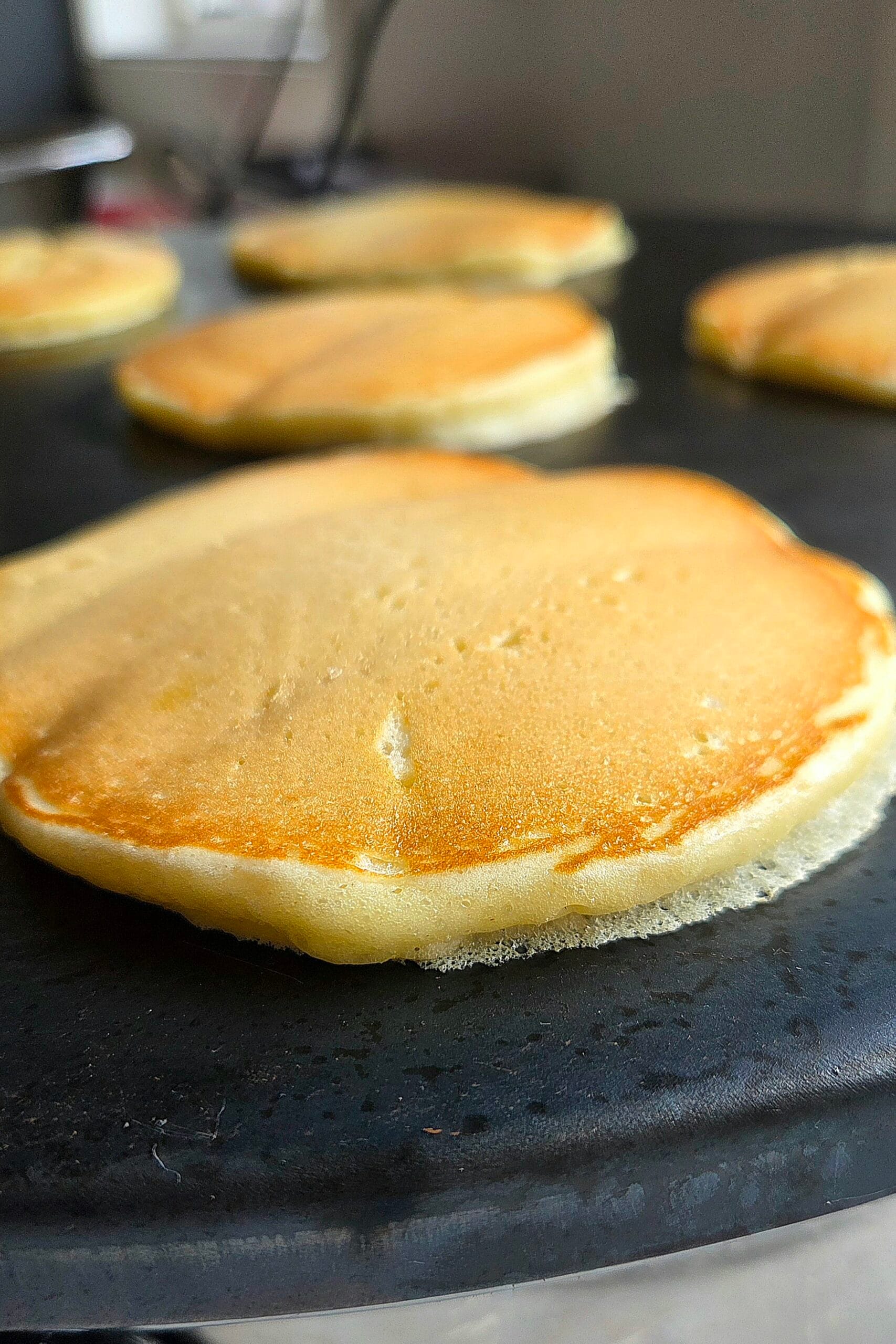
Norwegian sveler cooking on a black cast iron griddle, golden and puffed at the edges

Sveler — Norwegian Griddle Pancakes

Sveler are thick, soft Norwegian griddle pancakes from the west coast — the famous ferry recipe, served warm with butter and sugar.
Prep Time 15 minutes
Cook Time 40 minutes
Resting 15 minutes
Total Time 1 hour 10 minutes
Servings: 30 sveler
Course: Course, Dessert, Snack
Cuisine: Nordic, Norwegian, Scandinavian

Ingredients
  

Batter
  • 5 large eggs room temperature
  • 210 g granulated sugar 1 cup + 1 tbsp
  • 1 heaping tsp baking soda
  • 1 heaping tsp baker's ammonia hornsalt / ammonium bicarbonate — see notes for substitution
  • 1 l cultured buttermilk 4¼ cups
  • 600 g all-purpose flour 5 cups
  • 75 g butter ⅓ cup, melted and cooled slightly
For the pan
  • melted butter or neutral oil for greasing between batches

Equipment

  • Cast iron griddle or large flat cast iron pan A flat, heavy surface holds steady heat, which is the whole game with sveler.
  • Baker's ammonia (ammonium bicarbonate) The leavener that makes a svele a svele. Hard to find in US grocery stores, easy to order — one jar lasts years.
  • Digital kitchen scale We bake by weight for consistent results. The one we actually use.
  • Large balloon whisk You're whisking a full liter of batter smooth — a wide whisk does it in half the strokes.
  • Stand mixer For whipping the eggs and sugar to a proper pale, thick foam.
  • Thin metal turner Sveler are soft and thick; a thin, flexible edge slides under without tearing them.
  • Small ladle or ¼ cup scoop Same amount every time means every svele cooks in the same number of minutes.
  • Norwegian cheese slicer (ostehøvel) For shaving butter into thin curls straight onto a hot svele — the way it's done in Norway. A Norwegian invention, cheap, and it earns its drawer space.

Method
 

  1. Whisk the eggs, sugar, baking soda and baker's ammonia together until pale, thick and airy — about 3 minutes in a stand mixer. Don't rush this; the volume you build here is part of the lift.
  2. Whisk in the buttermilk until smooth.
  3. Add the flour and whisk until you have a smooth, lump-free batter.
  4. Stir in the melted butter last.
  5. Let the batter rest for 15 minutes. It will thicken noticeably as the flour swells — that's what you want.
  6. Heat a cast iron griddle or heavy flat pan over medium heat. Grease lightly with melted butter or oil, and wipe off the excess.
  7. Ladle roughly 3 tablespoons of batter per svele, leaving space between them. They should spread to about 4 inches across.
  8. Cook until bubbles come up across the whole surface and the edges look set and dry — about 2 minutes. Flip and cook another 1–2 minutes until golden.
  9. Stack them on a plate under a clean kitchen towel as they come off the pan. The trapped steam keeps them soft.
  10. Serve warm, with salted butter and sugar.

Notes

Chef's tip — don't skip the baker's ammonia. It's what gives sveler their dry, light, tender bite instead of a damp pancake crumb. The gas it releases needs a short way out, which is why it works on an open griddle and not in a deep cake. You may smell ammonia at the pan — that's normal, and it's gone by the time the svele hits the plate. More on why in the post below.
No baker's ammonia? Replace it with 1 teaspoon of baking powder. The sveler will still be good — a touch softer and more cake-like, slightly less of that clean, light bite.
Buttermilk. This recipe is built on Norwegian kulturmelk, which is a little thicker than American cultured buttermilk. Standard buttermilk works well. If your batter looks thinner than heavy cream after resting, whisk in another 2 tablespoons of flour.
Size is up to you. We ladle about 3 tablespoons per svele, which gives roughly 30 at 4 inches across. Go bigger — a scant ¼ cup — and you'll get closer to 25. Neither is more correct than the other.
Halving the recipe. This is a full ferry-galley batch. To halve it, use 2 eggs plus 1 egg yolk and halve everything else.
Storing and freezing. Sveler keep in an airtight container for 2 days and freeze beautifully — stack them with parchment between and freeze flat. Reheat straight from frozen in a dry pan over low heat, about a minute per side.