Ingredients
Equipment
Method
Before you start
- Blanch the walnuts. Bring a small pot of water to a boil, add the walnuts and boil for 1–2 minutes. Drain, rinse under cold water and drain well. Spread them out on a towel while you mix the dough. One blanch is enough, and they don't need to be bone dry — damp is fine.
Day 1
- Feed your starter the morning you bake (or the night before) so it's lively when you mix — it should have roughly doubled and look domed and bubbly. A spoonful floating in water is a good extra sign, but a whole grain starter can sink even when it's ready, so trust the rise first.
- Mix the dough. In a large bowl, whisk the starter into the lukewarm water to loosen it. Add all three flours and mix by hand until no dry flour remains — you'll have a shaggy, sticky dough. Hold the salt back for now. Cover and rest 1 hour at room temperature.
- Add the salt. Sprinkle it over the dough and work it in thoroughly, squeezing and folding until fully incorporated. The dough will tighten up slightly.
- Stretch and fold — every 30 minutes, at least 4 times — adding the walnuts on the second set. With a wet hand, grab one side of the dough, stretch it up, and fold it over the center; turn the bowl a quarter turn and repeat around the whole dough (four pulls = one set). On the second set, flatten the dough, scatter the walnuts over the surface and fold them in; the remaining sets will distribute them evenly. Our Stretch & Fold Timer keeps track of the sets for you.
- Bulk ferment until risen. After the folds, cover and let it rise at room temperature until it's grown by about 30–50%, looks domed and jiggly, and shows bubbles on top and along the sides. Depending on your kitchen this is roughly 4–6 hours total from mixing — the walnuts can slow it down a little, so give it the time it needs. Watch the dough, not the clock; our guide to bulk fermentation shows you what to look for.
- Preshape and shape. Tip the dough onto a lightly floured surface and gently round it into a loose ball. Leave it uncovered for 20–30 minutes so the gluten relaxes. Then fold it into a taut round, pulling it toward you against the counter a few times to build surface tension — more on that in how to shape sourdough. Press any walnut that pokes out back into the dough as you go.
- Into the banneton. Line your proofing basket with a cloth and dust it generously with rice flour, then set the dough in seam-side up.
- Cold retard overnight. Cover and refrigerate 12–16 hours. The slow, cold rise builds flavor and firms the dough so it's easier to score and springs higher in the oven.
Day 2
- Preheat, hot. About 45–60 minutes before baking, heat the oven as hot as it goes — around 480°F (250°C) — with your perforated baking tray on the middle rack and an empty metal roasting tray on the rack below. Both metal, never glass — glass can shatter when the water hits it.
- Turn out and score. Turn the cold dough out onto a sheet of parchment, seam-side down. Score it once, decisively, about ½ inch (1 cm) deep — see how to score sourdough.
- Bake with steam. Slide the loaf, still on its parchment, onto the hot baking tray in one quick movement. Immediately pour about 1 cup of just-boiled water into the roasting tray below and shut the door fast. Bake at 480°F (250°C) for 20 minutes.
- Finish in dry heat. Take the roasting tray out, drop the oven to 400°F (200°C), and bake another 15 minutes until the crust is deep brown and the center reads 205–210°F (96–99°C). Our guide to sourdough baking temperature explains the heat and steam in detail.
- Cool completely. Cool on a wire rack for at least 2 hours before slicing. A nut loaf holds moisture longer than a plain one — cutting early gives you a gummy crumb.
Notes
Chef's tip — blanch the walnuts. The bitterness sits in the papery brown skin, and a two-minute boil pulls a good part of it out — you'll see the water turn brown. Skip it and the bitterness carries into the crumb and sharpens as the loaf ferments.
- Damp walnuts are fine. Straight from the towel into the dough — no toasting, no drying. Just don't tip the draining water in with them.
- Sticky is right. The whole grain flours drink up water, so this sits around 73% hydration. It'll feel tacky — that's exactly what you want.
- Nuts slow things down. Walnut tannins are mildly hostile to gluten and to your starter, so this dough can ferment a touch slower and feel a little slacker than the plain loaf. Judge the dough, not the clock.
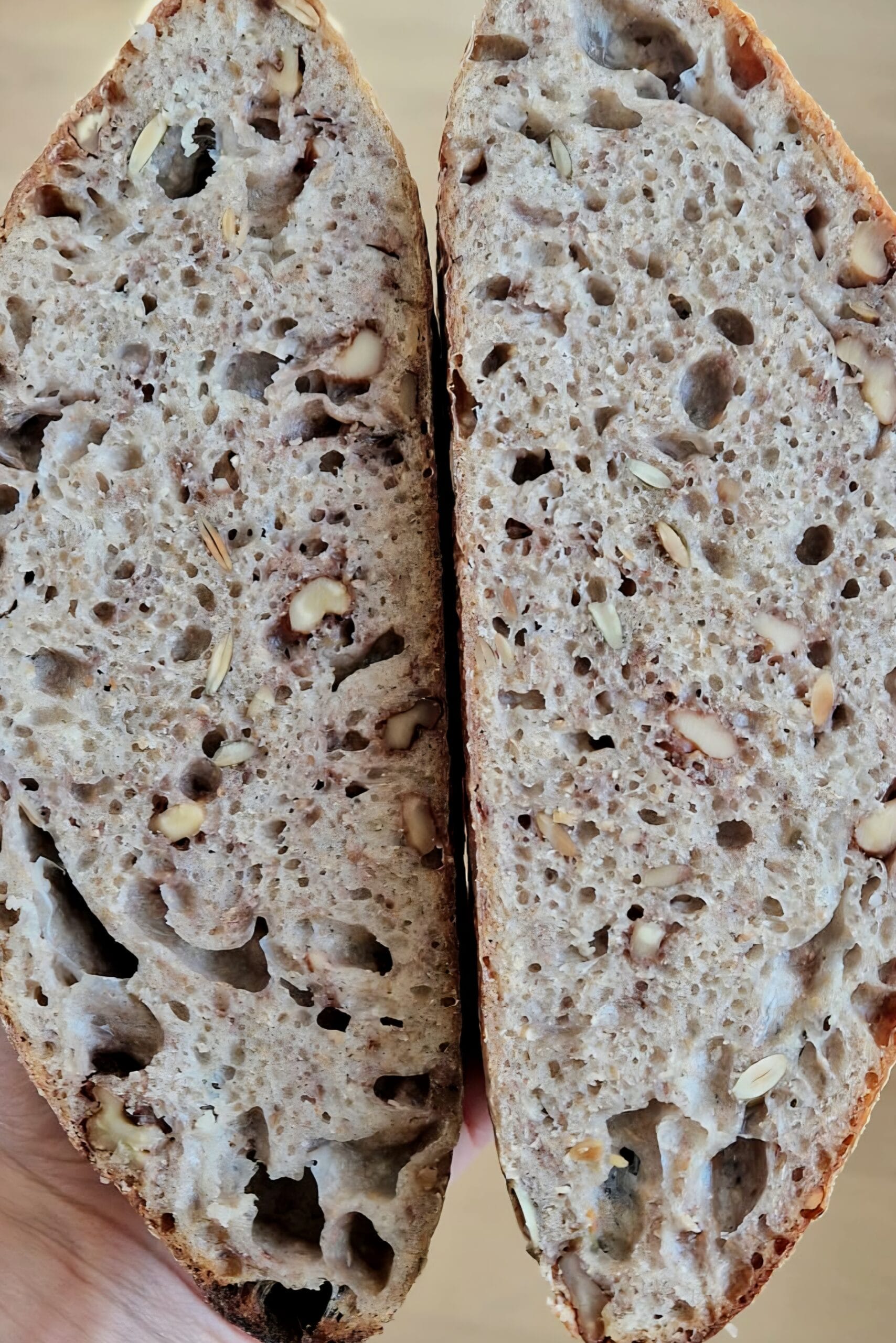
- A lavender tint is normal. Walnut tannins can turn the crumb around the nuts faintly purple-grey. Blanching reduces it; it doesn't affect the flavor.
- Weigh, don't scoop. A digital scale is the single biggest upgrade for consistent sourdough; the cup measures above are approximate.