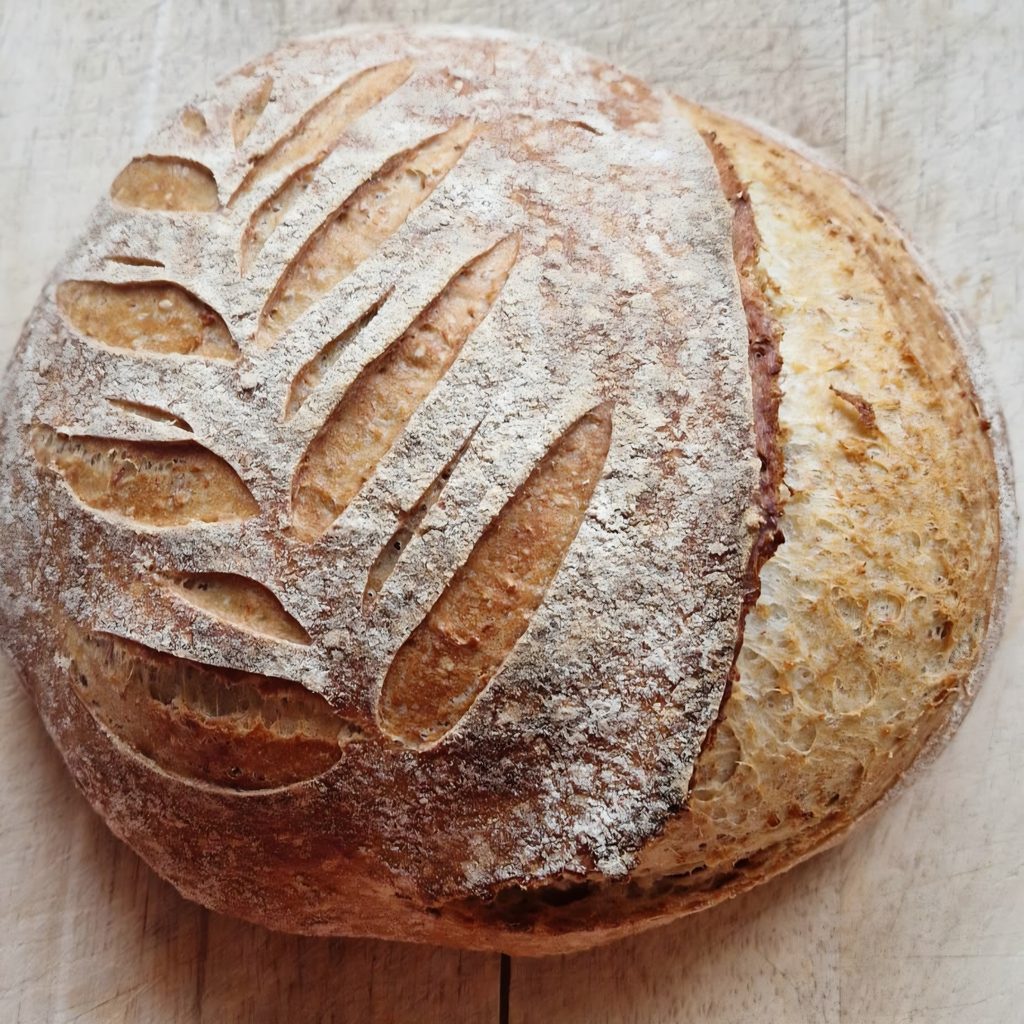
Learning how to score sourdough is the last step before the oven, and it’s more than decoration — that single cut controls how your loaf opens and rises in the heat. Score it well and you get a clean, dramatic burst and a taller loaf; skip it or do it badly and the bread tears wherever it likes. Here’s where to cut, how deep, and why it matters.
What Scoring Actually Does
Scoring is the cut you make in the surface of your dough right before it goes in the oven, and it has a real job. As the loaf hits the heat it springs — the gas expands fast and the dough wants to burst outward. Without a score, it bursts wherever it finds a weak spot, often along the side or bottom, tearing the loaf and flattening the rise.
A score gives that expansion a deliberate place to go. It’s a controlled weak point that tells the loaf where to open, so it blooms upward and outward in a clean, directed way instead of ripping at random. The dramatic “ear” you see on a good loaf — that raised, curled ridge, like the one on our caramelized onion sourdough — is the scored flap of dough peeling back as the bread springs. Scoring is what makes that happen. It’s function first, beauty second.
The Tool: A Lame
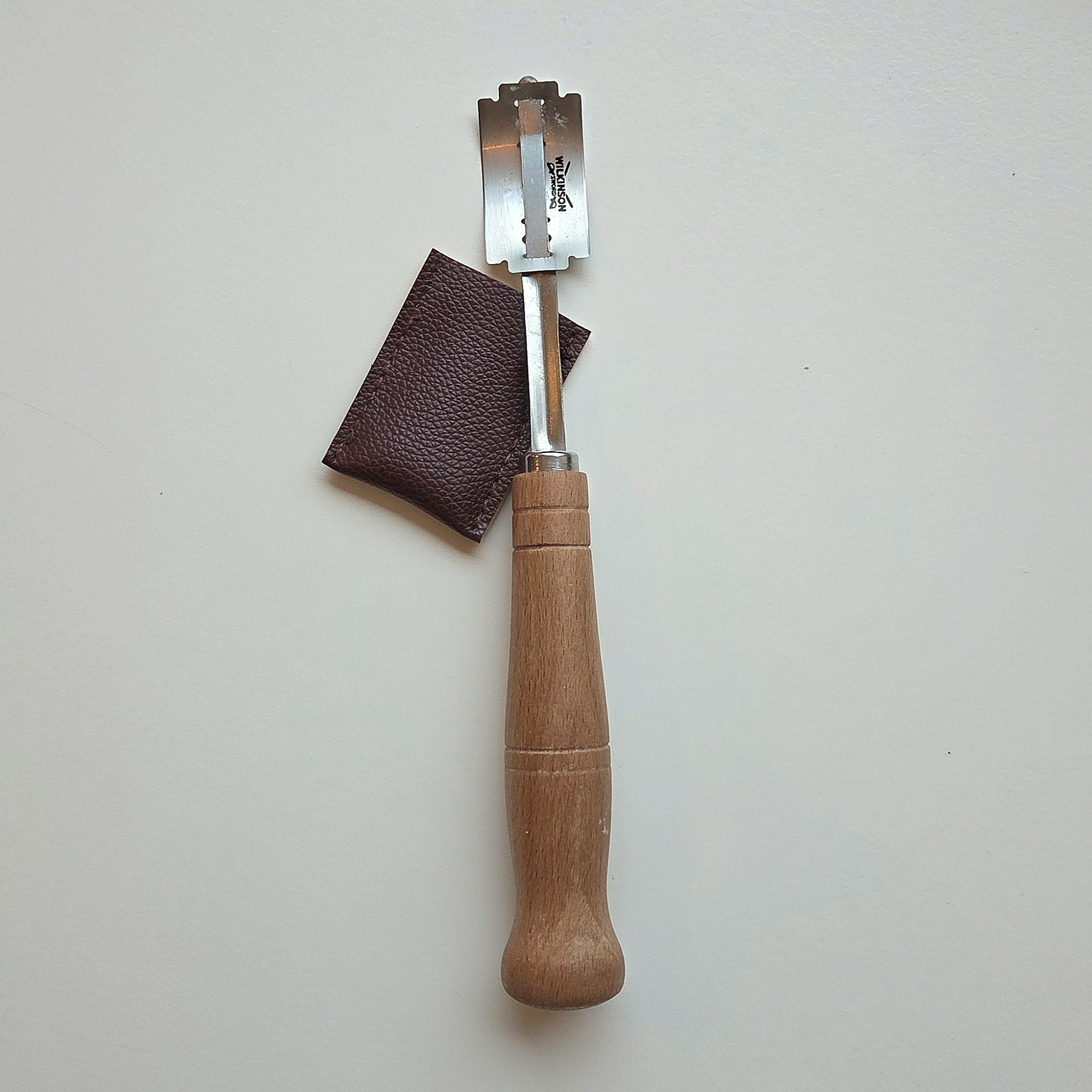
The standard scoring tool is a lame (pronounced “lahm”) — a thin razor blade on a handle, made specifically for slashing dough. The blade is what matters: it needs to be sharp enough to glide through the surface without dragging, because a dull edge snags the dough and pulls it instead of cutting cleanly.
A very sharp knife can work in a pinch, but a lame gives you far more control, especially for angled cuts. It’s an inexpensive tool that makes an outsized difference to how your loaves look and rise, and it’s one of the first upgrades worth making once you’re baking regularly.
How to Score Sourdough: Start With One Cut
If you’re new to this, forget the intricate patterns. Start with a single, confident slash — one long cut down the length of the loaf, or one curved cut along the side. That one score is all a loaf actually needs to spring well, and it’s exactly what our beginner sourdough bread uses.
There’s a reason to keep it simple beyond nerves: a single well-placed cut concentrates all the expansion in one place, which gives you the biggest, most dramatic ear and the best rise. Beginners who cover the loaf in decorative cuts often get a flatter result, because the spring is divided across all of them. Master one great slash before you move on to patterns — it’s the cut that does the work.
Baguettes are the exception: they take a row of short, overlapping cuts along their length. There’s more on that in our sourdough baguettes.
Angle and Depth
Two things separate a score that springs from one that doesn’t.
Angle. For that classic ear, hold the blade at a shallow angle — roughly 30 to 45 degrees to the surface — rather than straight down. This cuts a thin flap of dough rather than a vertical trench, and it’s that flap that lifts and curls into an ear as the loaf springs. A vertical cut opens, but it won’t give you the same dramatic lip.
Depth. Aim for about a quarter to half an inch deep — around 0.5–1 cm. Too shallow and the score seals over before it can open, so the loaf bursts elsewhere anyway. Too deep and you deflate the dough and lose structure. One confident, committed stroke at the right depth beats several timid scratches. Score decisively — hesitation is what drags and tears.
Functional vs. Decorative Scoring
It’s worth knowing the difference, because they’re not the same skill.
Functional scoring is the single cut that controls the spring — the slash down the middle or the curve along the side. Every loaf needs this, and it’s all you need for great bread.
Decorative scoring — a wheat stalk, leaves, intricate patterns — is artwork on top of that. It’s beautiful and genuinely satisfying to do, but here’s the honest part: most decorative patterns are shallow surface cuts that don’t drive the spring. They usually sit alongside one deeper functional score that does the real lifting. So the wheat stalk you admire on a finished loaf is almost always paired with a deeper cut doing the structural work. Learn the functional cut first; the art builds on top of it.
Cold, Firm Dough Scores Best
Here’s the tip that fixes most scoring frustration: score cold dough. A loaf straight from an overnight cold proof in the fridge is firm, taut and holds a crisp edge, so the blade glides and the cut stays open. Room-temperature, softer or wetter dough drags on the blade and the score blurs shut as you cut.
This ties back to two things. A slightly firmer, lower-hydration dough scores more cleanly than a very wet one (see our hydration guide), and a well-shaped loaf with real surface tension holds the cut open instead of slumping. If your scores keep dragging or closing up, the fix is usually colder, firmer, better-shaped dough — not a steadier hand.
Steam Keeps the Score Open
The last piece happens in the oven. For the first part of the bake, the surface of the loaf needs to stay soft and moist so the score can keep stretching open as the bread springs. Steam does that. Without it, the crust sets too early, the cut hardens before it opens, and the ear never lifts. Our guide to sourdough baking temperature shows how we make steam in a home oven with nothing more than a metal tray and a cup of boiling water.
Common Sourdough Scoring Mistakes
- Blade too dull. Drags and tears instead of cutting. Use a fresh, sharp blade.
- Cutting too slowly or timidly. Hesitation drags the dough. One confident stroke.
- Too shallow. The score seals over and the loaf bursts elsewhere. Commit to the depth.
- Dough too warm or wet. Score it cold and firm, straight from the fridge.
- Too many cuts. Divides the spring and flattens the loaf. Start with one.
- No steam. The crust sets before the score can open. Steam for the first 20 minutes.
The tool you need
Scoring is one place where the right tool genuinely changes the result — a sharp, purpose-made blade does what a kitchen knife can’t.
- A bread lame — the kind we use: a sharp, angled blade for clean cuts and a dramatic ear
Sourdough for Beginners · Step 8 of 9