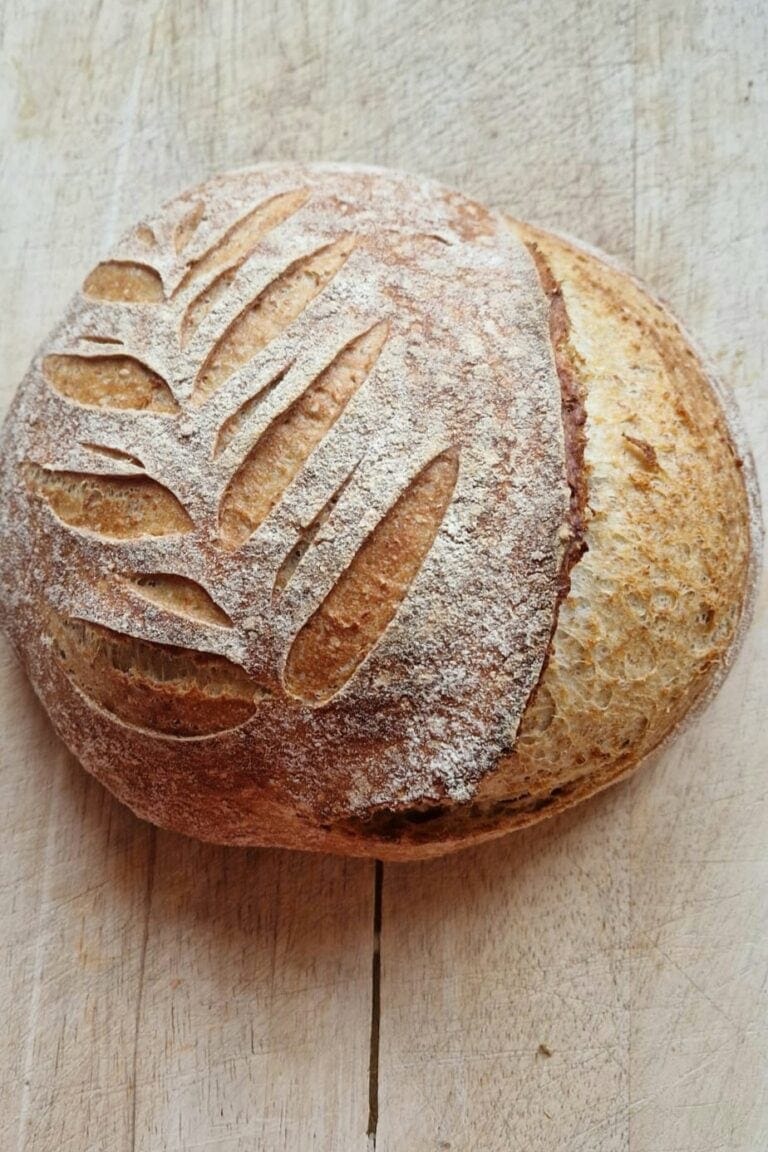
Caramelized Onion Sourdough Bread with Jarlsberg
Caramelized onion sourdough starts with a loaf you already know how to bake, our beginner sourdough bread, and loads it with something worth waiting for. We cook down over a pound and a half of onions until they’re sweet and jammy, fold them through the dough along with diced Jarlsberg, and let the whole thing ferment slowly overnight. It makes two savory loaves that eat like a meal on their own. Thick slices and good butter are all you need.
Caramelized Onion Sourdough Bread with Jarlsberg
Ingredients
Equipment
Method
- Brown the onions (day before, or the morning you mix)
- Slice and start. Slice the onions thin and add them to a heavy skillet with the oil over medium-low heat. No salt here — the dough and the cheese bring plenty.
- Brown slowly. Cook 45–60 minutes, stirring every few minutes. They will release water, collapse, then slowly turn deep amber and jammy. Don't rush this with high heat — you want sweet and soft, not scorched and bitter. 720 g raw cooks down to roughly 230 g.
- Cool completely. Spread them on a plate and refrigerate if needed. Warm onions will slacken the dough and throw off your fermentation — this matters more than it sounds.
- Feed your starter the morning you bake so it's lively when you mix — it should have roughly doubled and look domed and bubbly.
- Mix the dough. Whisk the starter into the lukewarm water to loosen it, then add both flours and mix by hand until no dry flour remains. Hold the salt back. Cover and rest 1 hour.
- Add the salt. Sprinkle it over and squeeze and fold it through until fully worked in. The dough tightens slightly.
- Stretch and fold — every 30 minutes, 4 sets. Wet hand, grab one side, stretch up, fold over the center, quarter turn, repeat around. Over these 2 hours the dough goes from shaggy to smooth and elastic. Our Stretch & Fold Timer keeps track of the sets.
- Fold in the onions and cheese on the last set. Spread the dough out, scatter the cold onions and the 240 g of diced Jarlsberg across it, then fold it up and over itself until they're evenly distributed. Work gently — the gluten is already built and you don't want to tear it.
- Bulk ferment until risen 30–50%. Roughly 4–6 hours total from mixing, depending on your kitchen. The dough should look domed and jiggly with bubbles along the sides. Watch the dough, not the clock; our guide to bulk fermentation shows what to look for.
- Divide in two. Tip the dough onto a lightly floured surface and cut it into two equal pieces, about 810 g each. Round each one loosely into a ball.
- Bench rest 20–30 minutes, uncovered. Don't skip this — the dough needs to relax before final shaping or it will fight you and tear.
- Shape each piece into a taut round, pulling it toward you against the counter a few times to build surface tension. With this much cheese and onion, a bench scraper does most of the work — see how to shape sourdough for the technique.
- Into the bannetons, seam-side up, in linen cloths dusted generously with rice flour.
- Cold retard 12–16 hours in the fridge. The cold firms the dough so it scores cleanly and springs high, and it deepens the flavor.
- Preheat hard. 45–60 minutes ahead, put the perforated baking tray on the middle rack and the metal roasting tray on the rack below, and heat the oven to 480°F (250°C).
- Score the cold loaves. Turn them out, dust off the excess flour and make one confident deep cut down the length of each with the lame. See how to score sourdough for angle and depth.
- Bake with steam, 20 minutes. Slide both loaves onto the hot tray, pour a cup of boiling water into the roasting tray below and close the door fast.
- Drop to 400°F (200°C), remove the steam tray, and bake 15 minutes more until the crust is deep brown and the cheese at the surface has caramelized. The loaves are done at 205–210°F (96–99°C) in the center.
- Cool completely on a wire rack — at least 2 hours. Slicing warm drags the melted cheese through the crumb.
Notes
- About the flours. Landhvete and emmer are both heritage wheats — sifted, so not quite whole grain. Outside Scandinavia, bread flour stands in for the landhvete, and sifted spelt for the emmer. Emmer flour is worth seeking out from a specialty mill if you can; it brings a mild sweetness that plain wheat doesn’t.
- Cheese swap. Any firm melting cheese works at the same 240 g — options are in the post below. Cut it in ¼-inch dice; shreds melt out and disappear into the crumb.
What makes this caramelized onion sourdough work
The dough itself is nothing new — it’s the same base we use for our beginner sourdough and our sourdough baguettes: 600 g flour, 400 g water, a ripe starter and salt. What changes everything is what goes into it, and when.
Nearly 500 g of onion and cheese against 600 g of flour is a heavy load. Add that early and you’ll shred a gluten network that hasn’t finished building. So we do all four sets of stretch and folds first, get the dough smooth and elastic, and only then spread it out and scatter the onions and cheese across it.
We also leave the onions unsalted. Between the 2.5% salt in the dough and 240 g of Jarlsberg, this loaf already has all the salt it needs — season the onions as well and you’ll taste it.
And the onions go in cold. Straight from the pan they’ll slack the dough and speed up fermentation in patches. Brown them the day before if that’s easier — the flavor is better for the wait anyway.
We divide the dough in two. A single 1.6 kg boule carrying this much onion and cheese is a lot to bake through evenly. Two smaller loaves handle better on the bench, bake more reliably, and give you twice the crust — which with browned onion and melted cheese on the surface is where a good share of the flavor sits. Same oven temperature, same 35 minutes.
What to expect when you cut it
A few things will look like mistakes the first time. They aren’t.
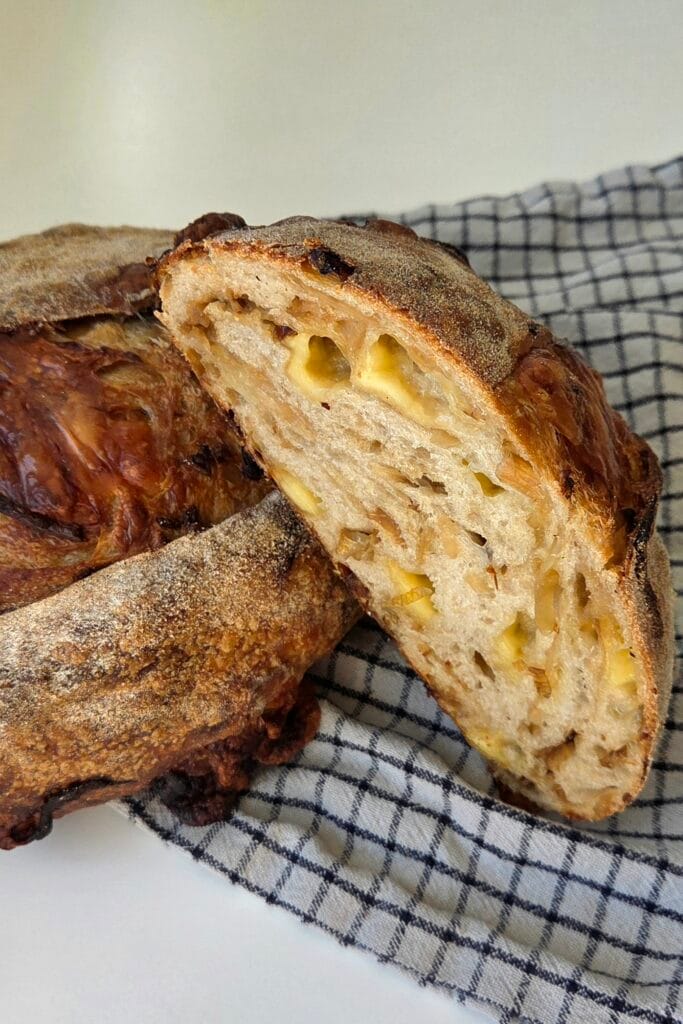
The crumb sits tighter than a plain loaf. That much inclusion interrupts the gluten structure, so this bakes up softer and closer rather than wide open. That’s the trade for the flavor, and it’s the right result — don’t chase an open crumb here.
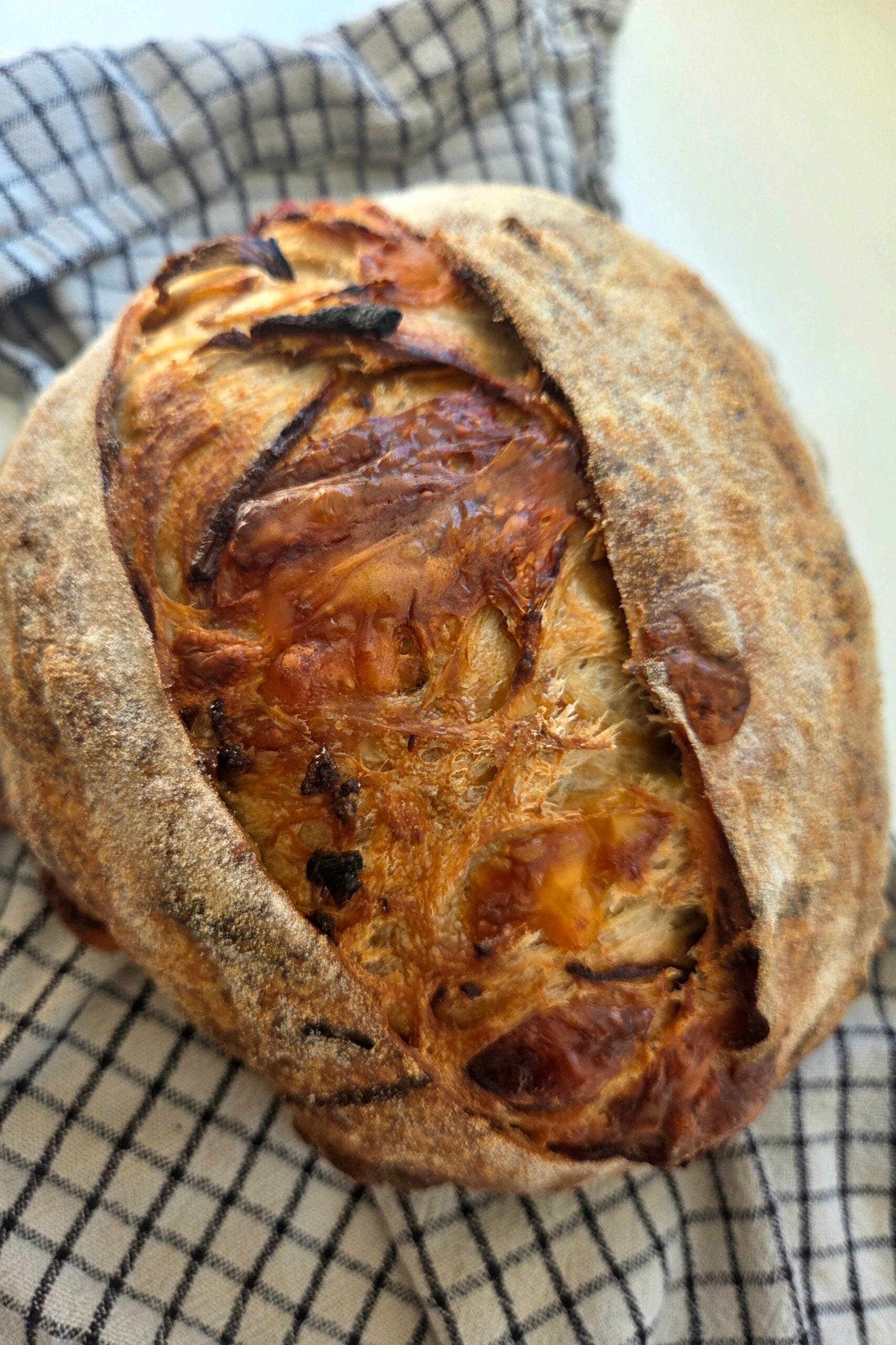
Cheese near the crust melts out and caramelizes. You’ll get crisp, savory patches where it has run onto the surface and browned. It’s the best bite in the loaf.
Any onion left on the outside goes dark. Pieces that poke through the crust catch more heat and color up almost black in places. There’s nothing wrong with that — it just tastes a little different there, deeper and more roasted, and it’s part of what gives this loaf its look.
Make it your own
Jarlsberg is the obvious choice for us, and its sweet, nutty edge is a natural match for browned onion. But any firm cheese that melts well will work: Gruyère and Comté push it richer and more savory, Emmental stays close to the Jarlsberg character, and a sharp cheddar gives it a tangier bite. Keep the weight the same at 240 g and cut it small — ¼ inch dice distributes far better than shreds.
A handful of chopped thyme or a grind of black pepper folded in with the cheese is worth trying if you want a third note. For a darker, denser loaf that tastes of the soup it’s named after, swap all the water for beef stock in our French onion soup sourdough.
Storing Caramelized Onion Sourdough
With this much cheese, it’s at its best within two to three days. Keep it cut side down on a board, unwrapped, at room temperature. Slice what you won’t eat and freeze it; toasted straight from frozen, the cheese melts again and the onion edges crisp up. A thick slice fried in butter is one of the best things you can do with the last of the loaf — see our leftover sourdough ideas for more
More from the Nordic kitchen
- Walnut Sourdough Bread — another loaf built on inclusions, folded with toasted walnuts
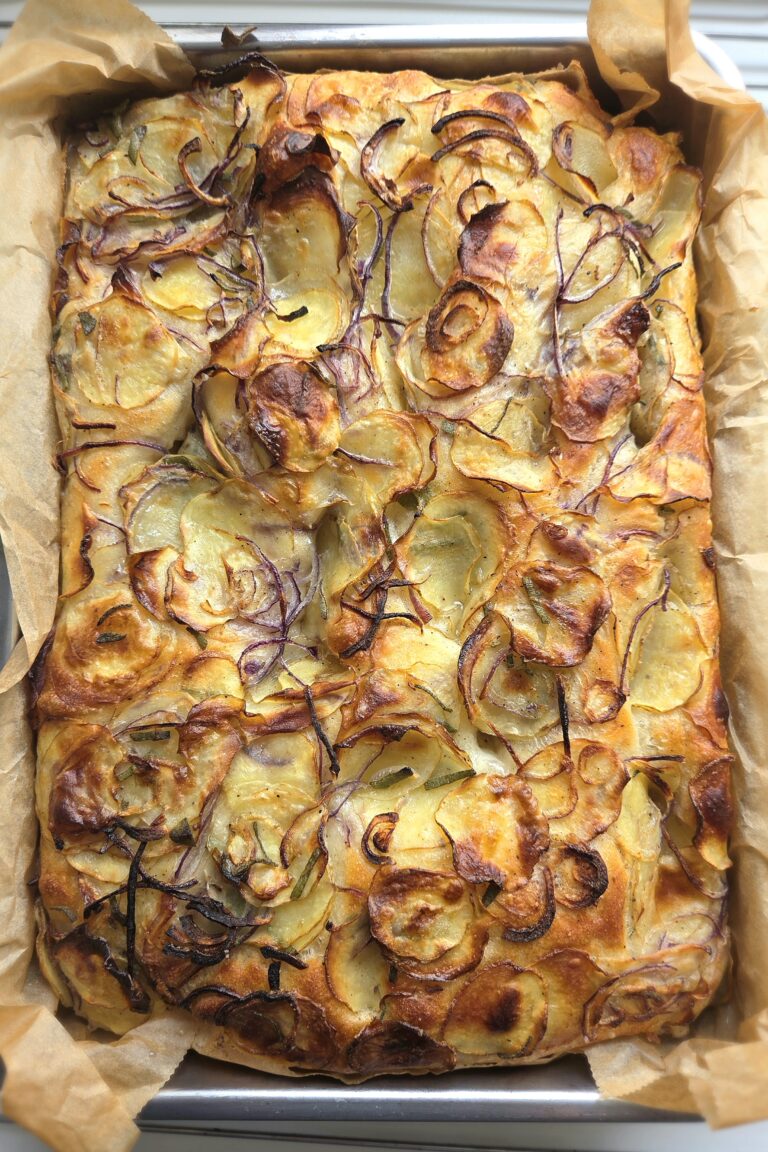
- Potato Focaccia with Red Onion and Sage — onion again, in a soft, olive-oil-rich bake
- Whole Grain Sourdough Bread — the everyday loaf, with no inclusions at all