Sourdough Bread Pudding with Blueberries
Sourdough bread pudding is the most useful thing we know to do with a loaf that’s past its best — cubed, soaked in a vanilla custard, baked under a thick layer of blueberries. It takes twenty minutes of work and turns half a stale loaf into a dessert that feeds twelve. This is the version we make most often at home, and the one trick that makes it worth the effort comes at the very end.
Sourdough Bread Pudding with Blueberries
Ingredients
Equipment
Method
- Preheat and line. Heat the oven to 325°F (160°C). Line a 9×13-inch pan with parchment, leaving an overhang on two sides.
- Trim and cube the bread. Trim off the hardest parts of the crust — the heel ends and any sections that have dried out properly. Cut the rest into ¾-inch (2 cm) cubes, softer crust and all, and tip them straight into the lined pan, spread level.
- Whisk the eggs. Whisk the eggs, sugar and vanilla sugar together until pale and foamy, about 2 minutes. You want air in there.
- Add the milk. Whisk in the milk.
- Pour and soak. Pour the custard evenly over the bread in the pan. Press the cubes down gently with your hand so everything is submerged, and let it sit for 30 minutes. Sourdough is drier and firmer than white sandwich bread, and it needs this time — skip it and you get dry cubes sitting in set custard.
- Top with berries. Scatter the frozen blueberries evenly over the surface, then sprinkle the 2 tbsp of sugar over the berries.
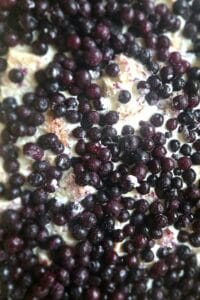
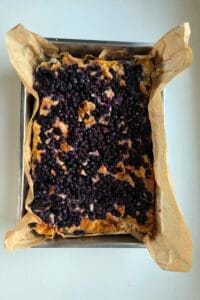
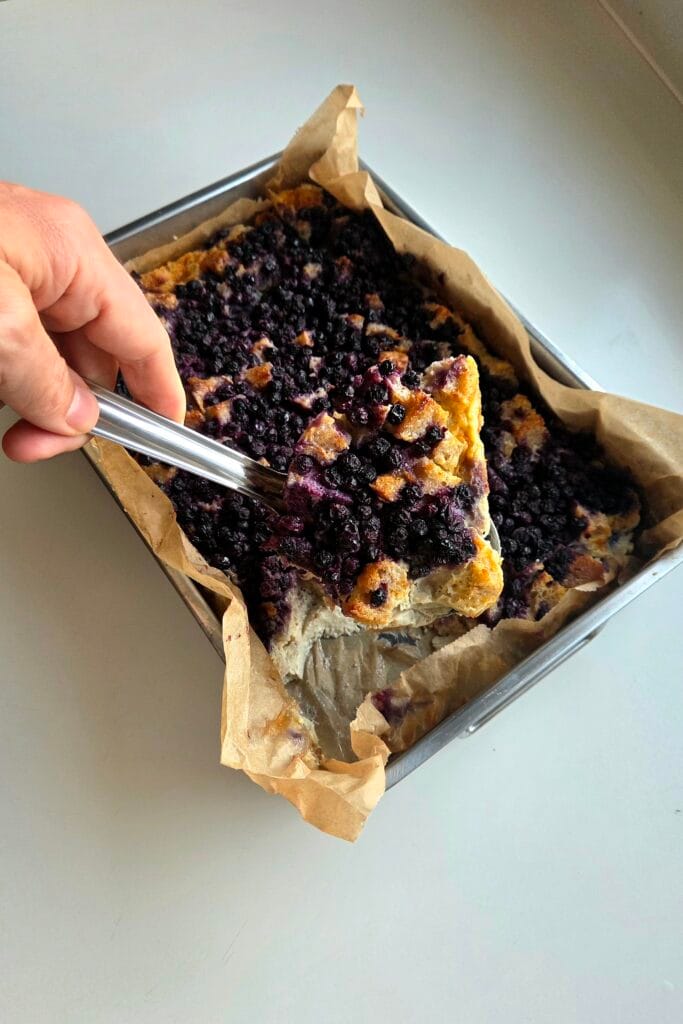
- Bake. Bake for 45 minutes, until the custard is set with only the faintest wobble at the center. If you're using a thermometer, the center should read 175–180°F (80–82°C).
- Rest. Let it rest 15–20 minutes before cutting. It firms as it cools, and cutting straight out of the oven gives you a collapsed edge.
- Serve. Serve warm, with a spoonful of Greek vanilla yogurt and a few frozen blueberries scattered over the top.
Notes
- Almonds: if you add them, scatter them on top before baking, never stirred into the custard. On top they toast; stirred in they go soft and disappear.
- Make ahead: assemble through step 5, cover the pan and refrigerate overnight. Add the berries and sugar in the morning and bake straight from cold — add 5–10 minutes.
- Storage: keeps covered in the fridge for 3 days. Reheat individual squares in a 325°F (160°C) oven for 10 minutes.
Why sourdough makes better bread pudding
Most bread pudding recipes call for brioche or white sandwich bread, and they work. But sourdough gives you two things neither of those can.
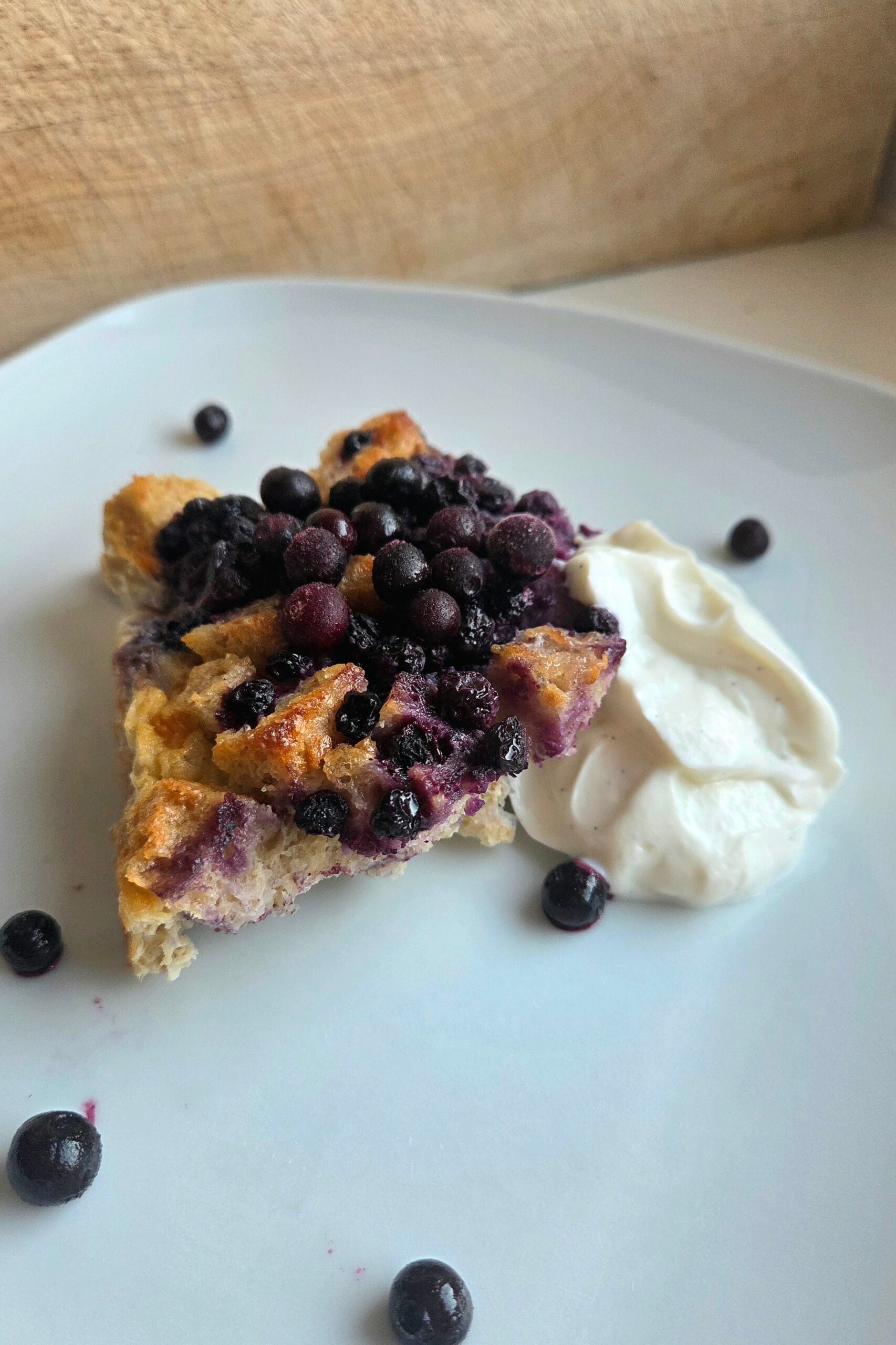
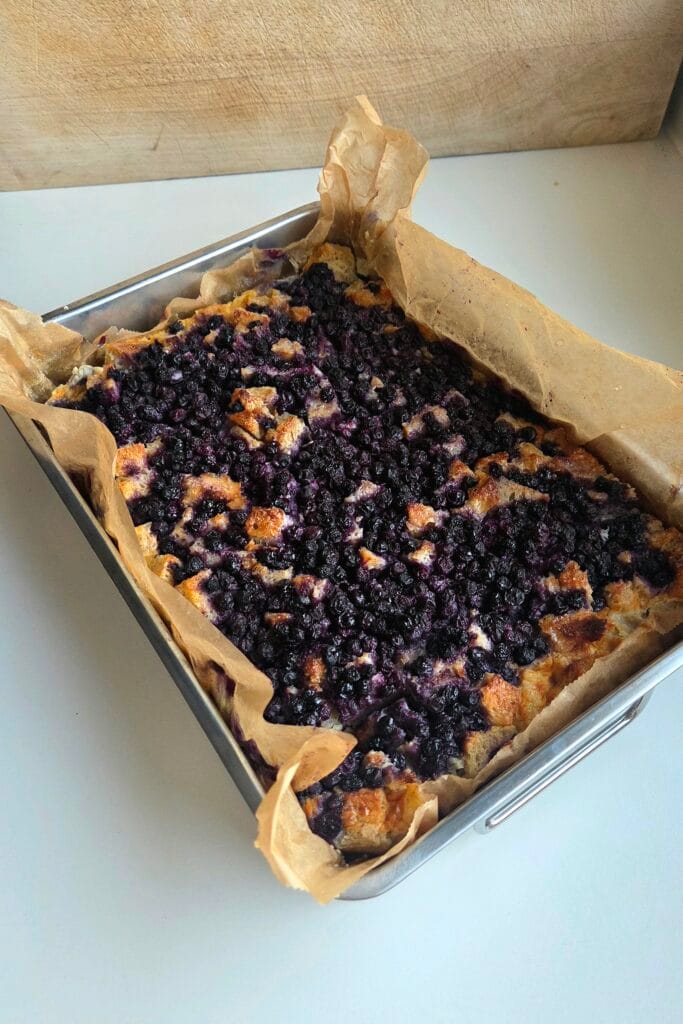
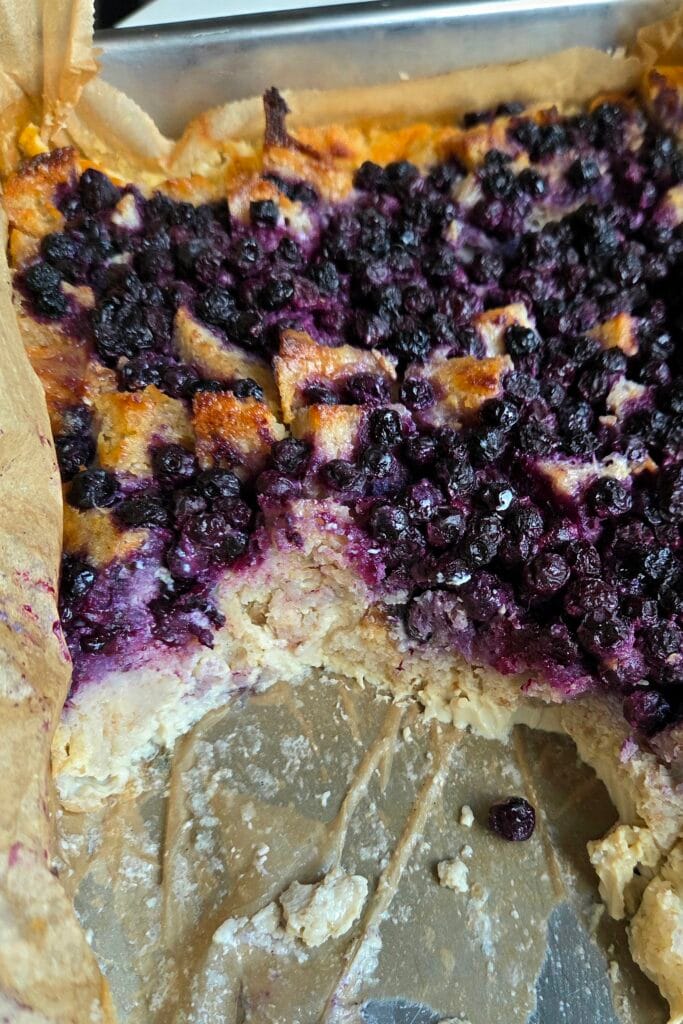
The crumb is stronger. A well-fermented loaf holds its structure through a long soak, so you get distinct cubes of bread in set custard rather than a uniform sweet mush. You can see it in the finished pudding — golden edges standing up out of the surface.
And the flavor has acidity in it. Bread pudding is a sweet dish, and the faint sourness of the bread cuts through that in a way white bread simply doesn’t.
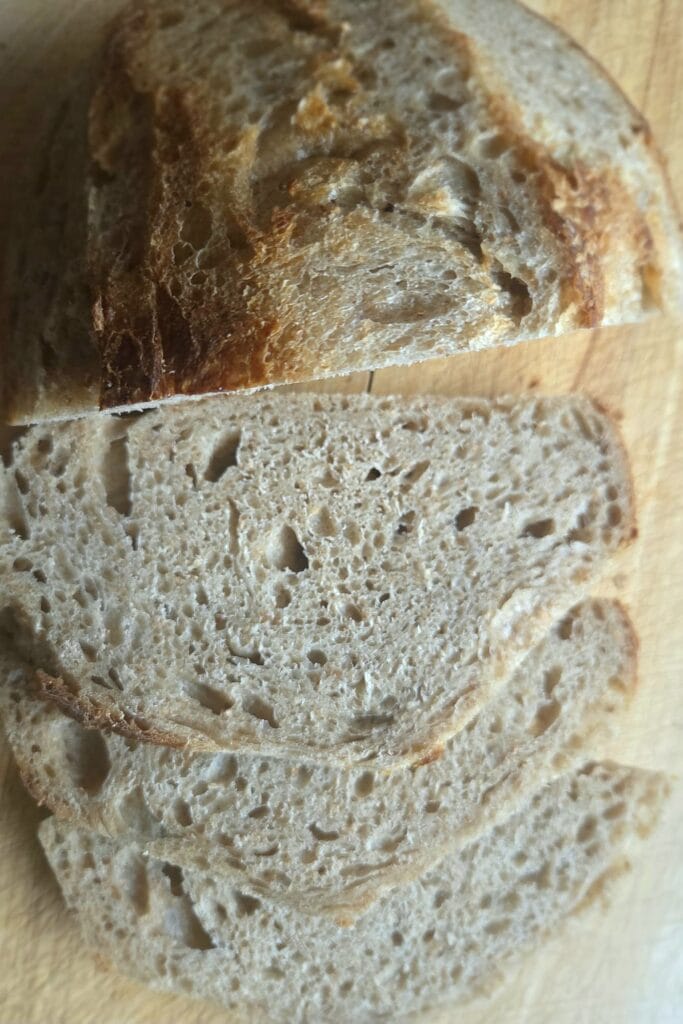
The only thing to get right is the age of the loaf. Two-day-old is ideal. Fresh bread collapses in the custard, and a loaf that’s gone properly hard has stopped absorbing evenly.
Cut away the hardest parts of the crust before you cube the bread. Sourdough crust is the best part of a fresh loaf, but it doesn’t soften in custard the way the crumb does — the heels and anything that’s gone leathery will still be tough after 45 minutes. Keep the softer crust; that’s what gives you the golden edges.
We make this with leftovers from our whole grain sourdough, which gives a darker, nuttier pudding with more chew to it. If you’d rather have something softer and more delicate, a lighter loaf like our beginner sourdough bread works just as well.
Give it thirty minutes to soak
This is the step people skip, and it’s the one that decides the result.
Sourdough is drier and denser than the breads most bread pudding recipes are built around. Pour custard over the cubes and put it straight in the oven, and the custard sets before the bread has taken any of it in — you end up with dry bread suspended in sweet egg.
Thirty minutes at room temperature is enough. Press the cubes down once with your hand so nothing is sitting proud of the custard — the pieces that stay dry never catch up.
There’s no need to mix anything in a bowl first. The bread goes straight into the pan and the custard gets poured over it. One less thing to wash, and you don’t break up the cubes by folding them around.
The berries go on top, not through
Four hundred grams of blueberries is a lot of fruit, and there’s a reason it all sits on the surface.
Folded through the custard, the berries bleed and turn the whole thing purple-grey. On top, they hold their shape, catch a little sugar and caramelize at the edges, and the juice runs down into the bread underneath instead of through it. You get color and contrast rather than a uniform mass.
Frozen berries are fine here — better, actually. They release their juice more slowly than fresh, which is exactly what you want when they’re sitting on the surface for 45 minutes. Wild or lowbush blueberries have more flavor than the big cultivated ones.
The trick at the end
Here’s the part that makes this recipe ours.
Baked fruit tastes cooked. That’s not a flaw — the jammy, concentrated flavor of the berries on top is most of what makes this dish good. But after 45 minutes in the oven, none of it tastes fresh anymore.
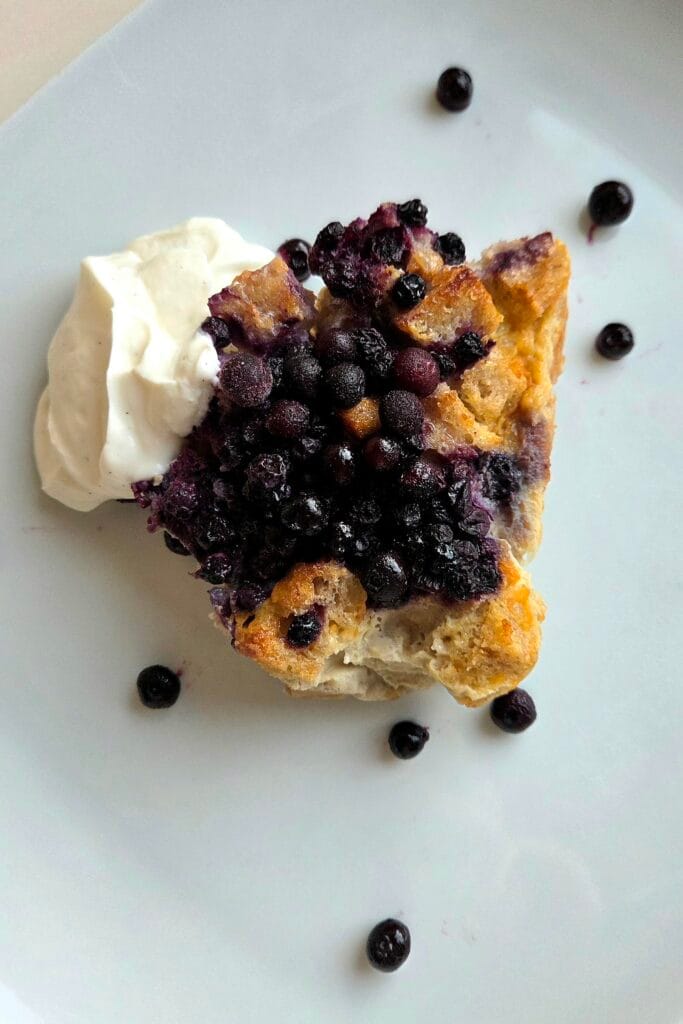
So we scatter a few blueberries straight from the freezer over each square as we serve it. Cold against warm, firm against soft, sharp against sweet. It costs nothing and takes five seconds, and it’s the thing people notice.
The Greek vanilla yogurt does the same job from a different direction. We started out serving this with whipped cream, which is the obvious choice and the wrong one — eight eggs and half a liter of milk is already rich, and cream just adds more of the same. Yogurt brings acidity. It’s the only component on the plate that isn’t sweet.
Use the thick Greek kind rather than a pouring yogurt. It holds its shape next to a warm square instead of running across the plate, and the extra body stands up to the pudding.
Make it your own
Almonds. A light scattering of roughly chopped almonds over the top before baking — about ⅓ cup (40 g) — gives you a bit of crunch against all that softness. Keep it light; the berries should still be what you see.
Other berries. Blackcurrants, raspberries or cherries all work the same way. Anything with acidity.
Breakfast version. Cut the topping sugar in half and serve it with plain Greek yogurt instead of vanilla. It’s a perfectly reasonable thing to eat at eight in the morning.
Fewer slices to use up? For a single portion of stale bread rather than half a loaf, our arme riddere — Norwegian French toast — does the same job in ten minutes.
More Nordic bakes you’ll love
Whole Grain Sourdough Bread — the loaf we usually have leftovers of
Norwegian Apple Trifle (Tilslørte Bondepiker) — another Nordic dessert built on leftover bread and fruit
More Nordic bakes you’ll love
- Whole Grain Sourdough Bread — the loaf we usually have leftovers of
- Norwegian Apple Trifle (Tilslørte Bondepiker) — another Nordic dessert built on leftover bread and fruit
Once you’ve baked it
- What to Do With Leftover Sourdough — our full guide to using up every last slice
- Sourdough Breadcrumbs — for the loaf that’s gone too far for bread pudding