Brown Butter Sourdough Bread
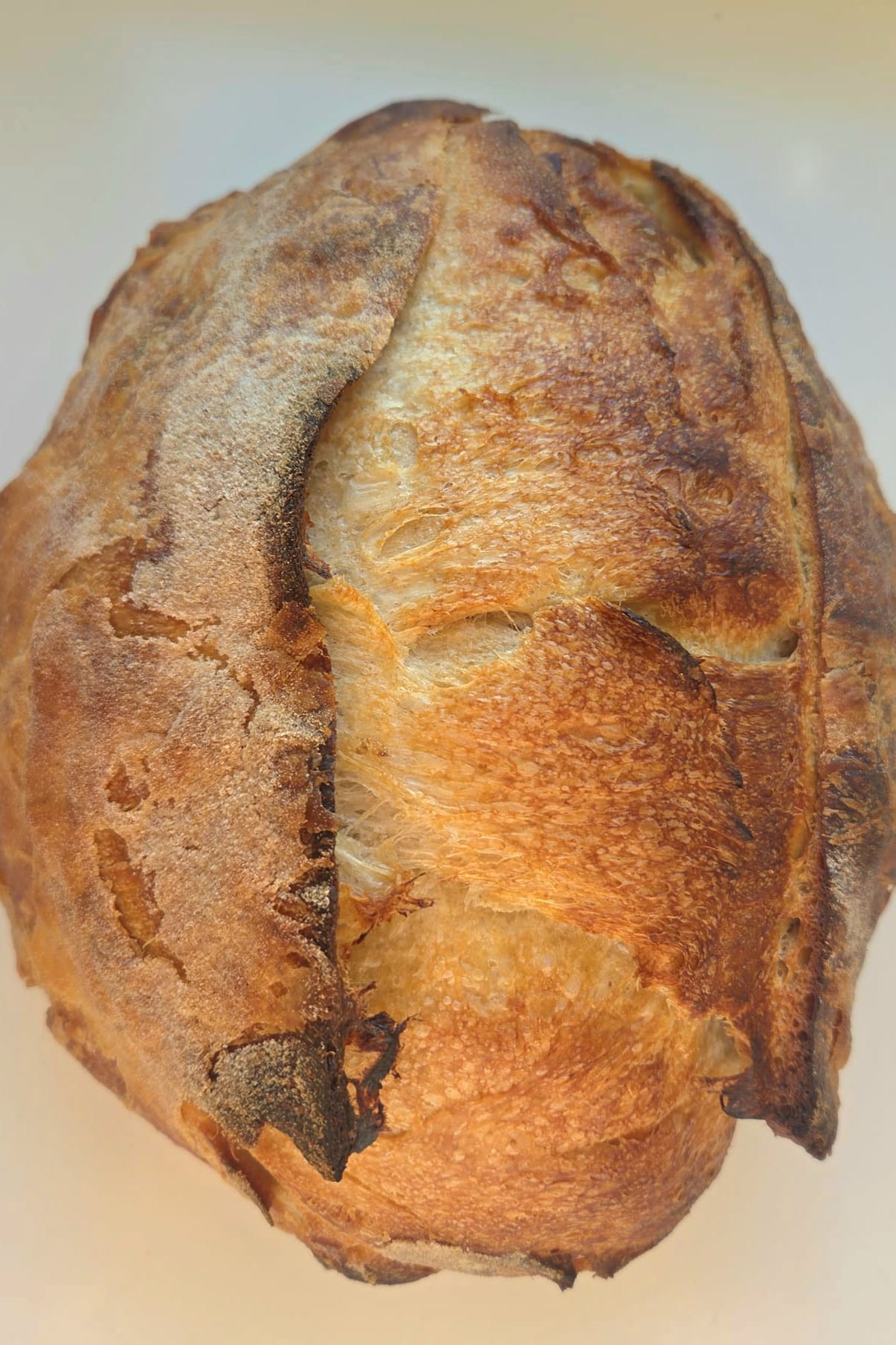
This brown butter sourdough takes our beginner sourdough bread and adds 100 g of frozen browned butter, grated in during the last two folds. It bakes up with a richer, more tender crumb than a plain loaf and a crust that flakes in thin sheets wherever the butter sat. The nutty smell of the browned butter carries all the way through to the finished bread.
Brown Butter Sourdough Bread
Ingredients
Equipment
Method
- Brown it. Melt the butter in a light-colored pan over medium heat. Let it bubble and foam, swirling now and then, until the milk solids at the bottom turn golden brown and it smells nutty — about 6–8 minutes. Pour it into a bowl, solids and all, and let it cool.
- Weigh and freeze. Weigh out 100 g of the cooled brown butter, spread it into a small container or on a plate, and freeze until solid. It needs to be rock hard before it goes anywhere near the dough.
- Feed your starter the morning you bake (or the night before) so it's lively when you mix — it should have roughly doubled and look domed and bubbly.
- Mix the dough. In a large bowl, whisk the starter into the lukewarm water to loosen it. Add the flour and mix by hand until no dry flour remains — you'll have a shaggy, sticky dough. Hold the salt back for now. Cover and rest 1 hour at room temperature.
- Add the salt. Sprinkle it over the dough and work it in thoroughly, squeezing and folding until fully incorporated. The dough will tighten up slightly.
- Stretch and fold — every 30 minutes, 4 sets — with the butter on sets 3 and 4. With a wet hand, grab one side of the dough, stretch it up, and fold it over the center; turn the bowl a quarter turn and repeat around the whole dough (four pulls = one set). Before the third set, grate half the frozen brown butter on the coarse side of a box grater directly over the dough, then fold it in. Repeat with the rest at the fourth set. Work quickly so the butter stays cold. The dough will feel slacker and look streaky — that's correct. Our Stretch & Fold Timer keeps track of the sets for you.
- Bulk ferment until risen. After the folds, cover and let it rise at room temperature until it's grown by about 30–50%, looks domed and jiggly, and shows bubbles on top and along the sides — roughly 4–6 hours total from mixing. Watch the dough, not the clock; our guide to bulk fermentation shows you what to look for.
- Preshape and shape. Tip the dough onto a lightly floured surface and gently round it into a loose ball. Leave it uncovered for 20–30 minutes so the gluten relaxes. Then shape it into a tight oval, building surface tension with a light hand — a higher-fat dough tears more easily. More on that in how to shape sourdough.
- Into the banneton. Line your proofing basket with a cloth and dust it generously with rice flour, then set the dough in seam-side up.
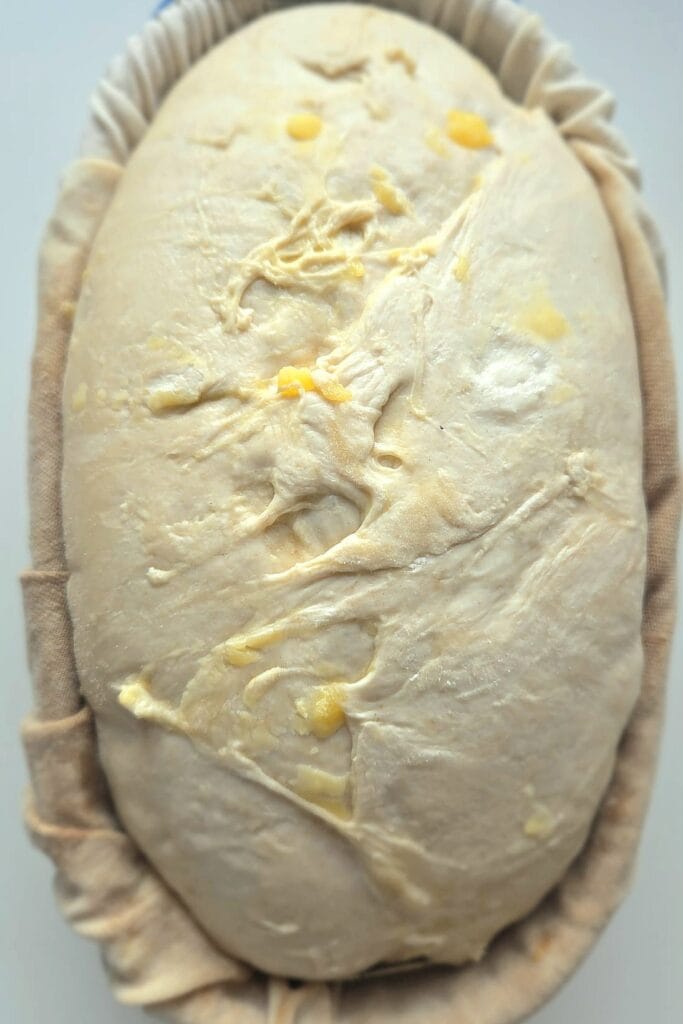
- Cold retard overnight. Cover and refrigerate 12–16 hours. The slow, cold rise builds flavor and firms the dough — and keeps the butter shards solid until the bake.
- Preheat, hot. About 45–60 minutes before baking, heat the oven as hot as it goes — around 480°F (250°C) — with a perforated baking tray on the middle rack and an empty metal roasting tray on the rack below. Both metal, never glass. You're not waiting for the air to heat up; you're waiting for the trays to load up with heat.
- Turn out and score. Tip the cold loaf onto a sheet of parchment, seam-side down, and score it with one confident stroke about ½ inch (1 cm) deep — see how to score sourdough.
- Bake with steam. Slide the parchment onto the hot tray, immediately pour about 1 cup (250 ml) of just-boiled water into the roasting tray below (stand back), and shut the door fast. Bake at 480°F (250°C) for 20 minutes. Don't open the oven during this stage — every peek costs you steam, and steam is what gives you the ear.
- Finish in dry heat. Pull out the roasting tray, drop the heat to 400°F (200°C) and bake another 15 minutes, until the crust is deep golden and the center reads 205–210°F (96–99°C). Start checking at 10 minutes — the butter darkens the crust faster than a lean loaf, especially along the score. Our guide to sourdough baking temperature explains the heat and steam in detail.
- Cool completely. Cool on a wire rack for at least 2 hours before slicing. Cutting too early makes the crumb gummy.
Notes
- Weigh after browning, not before. Butter loses water as it cooks; the recipe is built on 100 g of finished brown butter.
- Keep the solids. Scrape everything from the pan into the bowl — the browned milk solids are where most of the flavor lives.
- Got a Dutch oven? You can bake covered instead: lower the loaf into a screaming-hot pot, lid on, 20 minutes at 480°F (250°C), then lid off at 400°F (200°C) for the last 15 — no water tray needed.
Why frozen butter, and why so late
Fat and sourdough have a complicated relationship. Butter coats gluten strands, and if you add it early it slows down the network you’re trying to build. The dough goes slack, bulk drags, and you lose the structure that makes sourdough worth the wait.
Adding it at the third and fourth folds sidesteps all of that. The gluten is already there. The butter has nothing left to interfere with — it just gets folded in between existing sheets of dough.
Freezing it is the other half. Grated frozen butter goes in as hard shards, and hard shards survive shaping. They sit there through the whole cold proof and only melt once the loaf hits the oven, leaving thin planes of fat behind. Soft butter smears and disperses and gives you a uniformly richer dough — pleasant, but it isn’t this.
That’s the whole recipe in one line: freeze it, grate it coarse, add it late.
What Brown Butter Does to Sourdough Bread
Two things, and it’s worth being clear about which is which.
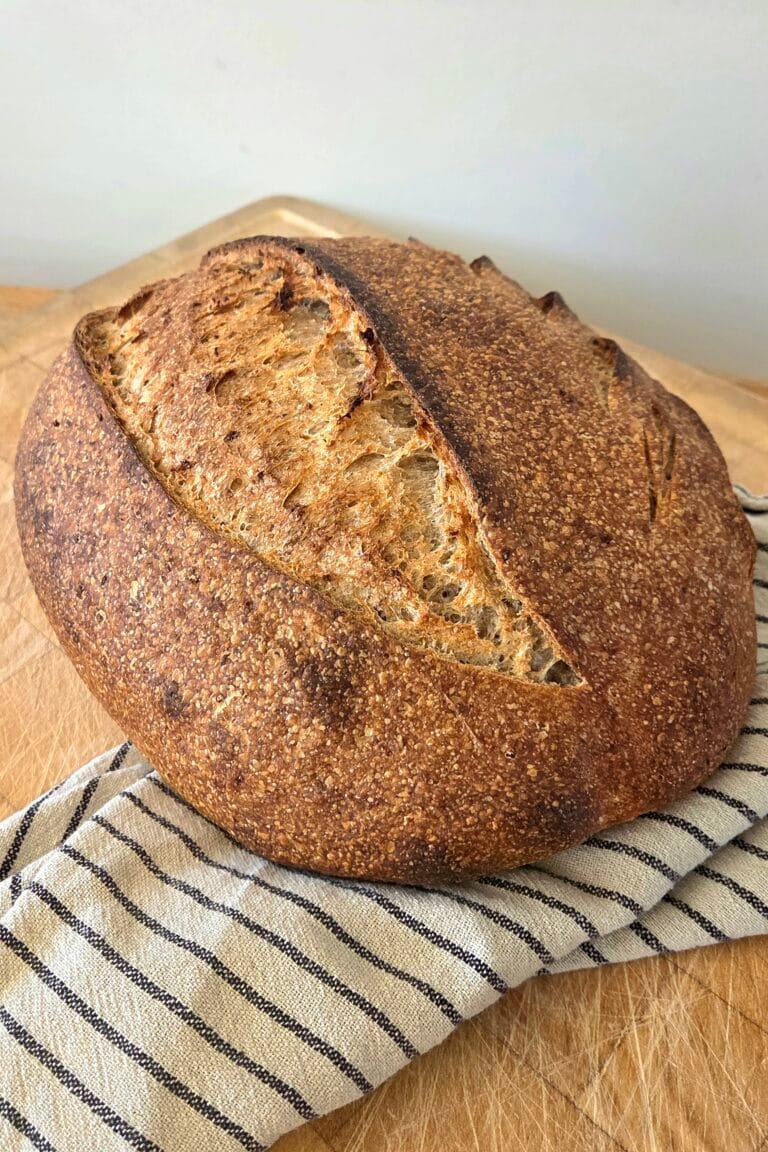
The crust picks up thin flaking layers along the score and across the top. Not croissant lamination — the same idea at a much smaller scale. Where the shards sat closest to the surface, the crust separates into brittle sheets instead of one solid shell.
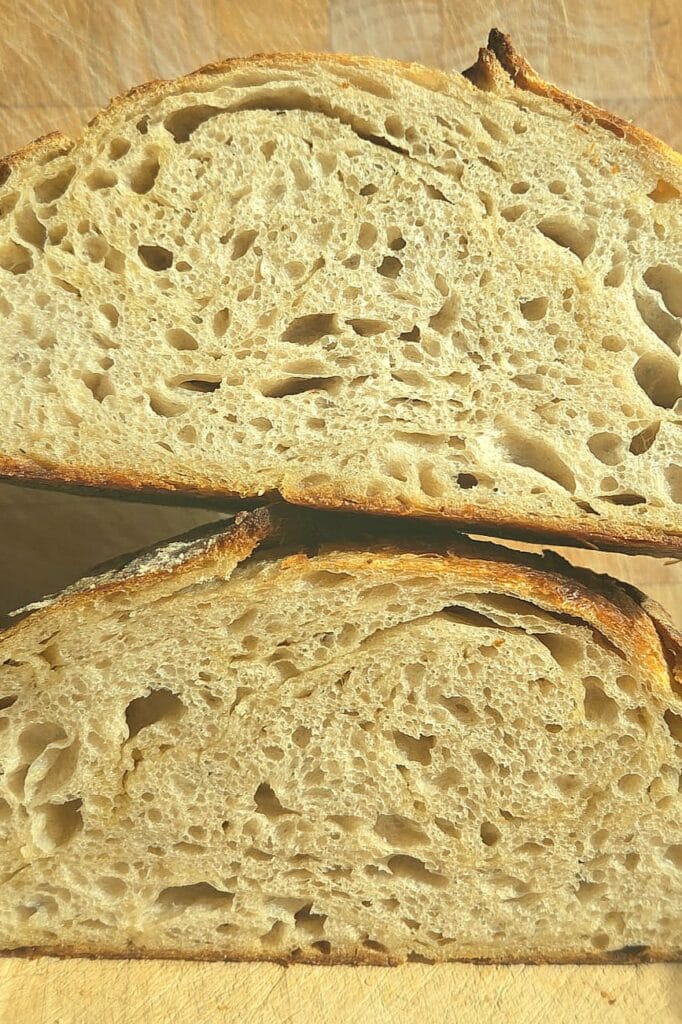
The crumb gets softer and moister rather than more open. If you’re chasing large irregular holes, butter works against you — our guide to sourdough hydration covers what opens a crumb instead. What you get here is a fine, tender crumb that eats more like a rich table bread than a lean country loaf.
Getting the browning right
Use a light-colored pan so you can actually see the milk solids change. The butter foams, goes quiet, then starts smelling nutty — that’s the signal, and it arrives faster than you expect. Pull it off the heat while it’s golden brown, not dark, and get it out of the pan straight away. A hot pan keeps cooking it.
Scrape everything into the bowl, solids included. That’s where most of the flavor lives.
And weigh it after browning, not before. Butter loses water as it cooks, and this recipe is built around 100 g of finished brown butter.
A darker score is normal here
The extra fat means the crust colors faster than it would on a lean loaf, and it colors fastest right along the score, where butter migrates toward the surface as the bread opens up. Expect that cut to go deep brown while the rest of the loaf is still golden. It’s not burnt — it’s what a well-baked enriched sourdough looks like.
Start checking at the ten-minute mark of the second stage rather than waiting out the full fifteen.
Storing Brown Butter Sourdough
The butter keeps this loaf soft a day longer than a lean one. Cut side down on a board, no plastic, it’s good for three days. For longer, slice it and freeze it; toasted straight from frozen, the crust flakes all over again. Leftover slices make exceptional arme riddere — the butter is already in the bread.
Make it your own
Brown butter takes a few additions well, as long as you keep the fat at 100 g:
- Honey glaze — brush the loaf with a little warm honey straight out of the oven for a darker, glossier crust.
- Flaky salt — a pinch scattered over the loaf just after scoring plays directly against the nutty butter.
- Whole grain swap — replace 100 g of the bread flour with sifted whole wheat for a slightly earthier loaf. Expect a tighter crumb; our flour guide explains why.
More from the Nordic kitchen
- Caramelized Onion Sourdough Bread with Jarlsberg — another loaf built on a late addition, loaded with onion and cheese
- Walnut Sourdough Bread — a nutty whole grain loaf, with walnuts folded through on the second set
- Whole Grain Sourdough Bread — the everyday loaf to move on to